

The difference between healing and harming comes down to a single invisible particle. When medicine enters your bloodstream directly, your body loses its natural defenses against contaminants. This reality forces the pharmaceutical industry to operate under some of the most rigorous environmental standards on Earth. We call this process sterile manufacturing, and it is far more complex than simply cleaning a lab bench.
You might assume that all drug production follows similar protocols, but the stakes for injectables are uniquely high. A contaminated pill might cause stomach upset, but a contaminated injection can trigger sepsis or death. The history of these standards is written in tragedy. The 1955 Cutter Laboratories polio vaccine incident and the 2012 meningitis outbreak linked to compounding pharmacies drove regulators to enforce strict controls. Today, every vial that reaches a hospital shelf has survived a gauntlet of physical, chemical, and biological checks designed to ensure zero tolerance for failure.
Global Standards and Regulatory Frameworks
Before building a single factory, manufacturers must align their operations with a web of international laws. These regulations aren’t suggestions; they are legal requirements enforced by bodies like the Food and Drug Administration and the World Health Organization. Compliance dictates how you design facilities, train staff, and validate equipment.
The FDA operates under 21 CFR Parts 210 and 211, setting the baseline for Current Good Manufacturing Practice (cGMP) in the United States. For European markets, EU GMP Annex 1 (revised in 2022) became the global benchmark. Meanwhile, the World Health Organization (WHO) established the concept of Sterility Assurance Level (SAL).
The SAL metric measures the probability of non-sterile units remaining after processing. WHO Technical Report Series No. 961 mandates that injectables maintain a contamination probability of less than one in one million (10^-6). If you run 100,000 batches and even one fails, you likely breached this standard. This requirement applies to every product entering the sterile suite, from small-volume parenterals like syringes to large-volume IV bags used in hospitals.
Core Manufacturing Methods
There are two primary ways to achieve sterility, and choosing the right one depends entirely on the drug's chemistry. Heat destroys bacteria, but it also destroys fragile proteins. If you are making a robust salt solution, boiling is fine. If you are making a monoclonal antibody, heat ruins the medicine. This trade-off drives the entire facility design.
| Method Characteristics | ||
|---|---|---|
| Method | Terminal Sterilization | Aseptic Processing |
| Temperature/Treatment | Steam at 121°C or Gamma Radiation | No terminal heat treatment |
| Product Suitability | Heat-stable solutions (~40% of injectables) | Biologics, heat-sensitive molecules |
| Cost per Batch | $50,000 (approx.) | $120,000 - $150,000 |
| Risk Profile | Low (process validated heat kill) | High (relies on continuous control) |
Terminal sterilization is the preferred method because it offers a higher margin of safety. You fill the container, seal it, and then subject the entire batch to steam or radiation. This achieves an SAL of 10^-6 reliably. However, about 60% of new drug approvals in 2023 were biologics. These complex proteins unfold and clump when heated. For them, you must rely on aseptic processing. This means maintaining a sterile environment throughout filling and sealing, ensuring no pathogen ever touches the product before it leaves the line.
Cleanroom Classifications and Environmental Control
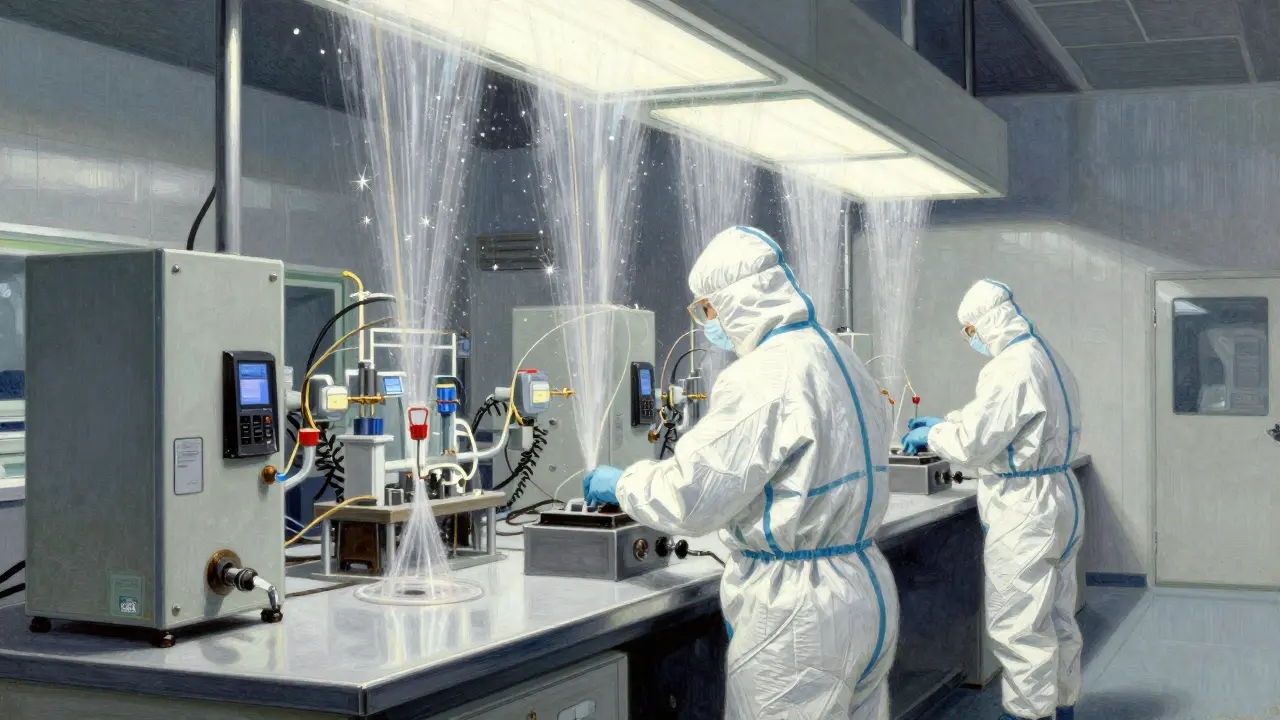
In an aseptic suite, the air itself is treated as a raw material. You cannot breathe normally in these spaces without risking contamination. Facilities utilize ISO classified cleanrooms, graded by particle density. As you move toward the critical filling zone, the cleanliness requirement tightens dramatically.
Class 100 (ISO 5) environments allow fewer than 3,520 particles per cubic meter that are 0.5μm or larger. This level is reserved for the "Grade A" zones where open vials are exposed. Surrounding these areas are Grade B (ISO 5 or 6) buffer zones and Grade C/D anterooms that protect the inner sanctum from the outside world.
Operators wear full-body protective suits, known as bunny suits, which are constantly flushed with HEPA-filtered air.Airflow dynamics are critical. Unidirectional airflow moves at speeds of 0.3 to 0.5 meters per second, pushing particles away from critical surfaces. Pressure differentials matter too. Adjacent rooms must differ by 10-15 Pascals to ensure air flows from cleaner to less clean areas. Humidity is controlled between 45% and 55% relative humidity. Too much moisture encourages microbial growth, while too little creates static electricity, attracting particles to product packaging. Temperature stays steady at 20-24°C to protect both personnel comfort and product stability.
Critical Inputs: Water and Pyrogens
Sterility isn’t just about killing germs; it is about removing toxins. Pyrogens are fever-inducing substances produced by bacteria. Even if you sterilize the water, pyrogens can survive standard heating. Water for Injection (WFI) is the primary solvent for most injectables. It must meet extremely low endotoxin limits, specifically less than 0.25 Endotoxin Units (EU) per mL according to USP <85>.
Containers themselves pose a challenge. Glass vials and rubber stoppers undergo depyrogenation at 250°C for 30 minutes. This heat cycle destroys bacterial endotoxins adhering to the glass surface. Validation requires calculating an Fh value (a measure of equivalent exposure time at 250°C) of at least 1365 minutes. If your autoclave cycle is interrupted, the batch is compromised. Manufacturers track these cycles meticulously using biological indicators to prove the kill step was effective.

Economic Realities and Inspection Risks
Running a sterile facility demands significant capital. Setting up a small-scale operation for injectables costs between $50 and $100 million. Once operational, vigilance is expensive. Media fill simulations (where you simulate the process using nutrient broth instead of drug) are required regularly. If you see bacterial growth in these tests, your facility is not sterile enough to handle real medicine.
Data from the FDA inspection database shows that 68% of deficiencies in sterile facilities relate to aseptic technique failures. These are often human errors during gowning or handling. While isolators reduce contamination risk significantly compared to Restricted Access Barrier Systems (RABS), they require a 40% higher capital investment. Many companies weigh this trade-off carefully. A media fill failure can cost $1.2 million due to batch loss and requalification time. Consequently, continuous monitoring systems are replacing periodic checks. Sensors now track particle counts in real-time rather than sampling once a shift.
Future Trends in Sterile Technology
We are moving toward fully automated facilities. By 2027, robotic filling systems are expected to grow by 40%. This trend aims to minimize human presence in critical zones. The human element remains the biggest variable in contamination risk. Advanced digital twins allow operators to simulate process changes before running a physical test. Furthermore, rapid microbiological methods are cutting testing times from 14 days down to 24 hours, speeding up batch release to get life-saving drugs to patients faster.
What is the acceptable contamination rate for injectables?
Regulatory bodies like the WHO require a Sterility Assurance Level (SAL) of 10^-6. This means statistically less than one non-sterile unit should exist in a million processed units.
How do you sterilize heat-sensitive biologic drugs?
Heat-sensitive products use aseptic processing. Instead of heating the final product, manufacturers maintain a sterile environment (ISO 5 cleanrooms) throughout filling and sealing to prevent initial contamination.
What are the main costs involved in sterile manufacturing?
Initial setup requires $50-$100 million. Ongoing costs for aseptic processing range from $120,000 to $150,000 per batch due to strict environmental controls, monitoring, and validation requirements.
Why is water quality so critical in this process?
Water for Injection (WFI) is the primary solvent. It must be free of endotoxins (<0.25 EU/mL) and particulates, as any impurity is delivered directly into the patient's bloodstream without filtration.
How often do facilities fail inspections?
Inspection data indicates that 68% of deficiencies in sterile manufacturing sites involve aseptic technique failures, highlighting that human error remains the primary risk factor despite technological advances.
Goodwin Colangelo
April 2, 2026 AT 05:08The capital expenditure figures really shock new entrants into the space. Five to ten figure investments are standard before you even fill your first vial. We often forget that water purification systems alone can dwarf smaller company budgets. Regulatory compliance requires ongoing investment rather than a one-time setup fee. Media fill simulations need to happen regularly to keep the site qualified. You see batch losses costing millions when validation fails unexpectedly. Training staff on gowning procedures takes weeks of dedicated time. The isolation technology helps mitigate human error significantly. Companies using RABS versus isolators weigh the ROI carefully. It remains a high barrier to entry for generic manufacturers too. Safety margins dictate every dollar spent on facility design. We focus heavily on risk management during facility planning phases. Validation protocols ensure that every piece of equipment works correctly. Traceability of data points prevents contamination issues later. Quality teams work overtime to review audit findings annually. Consistency is the primary goal in every single production step.
Beth LeCours
April 4, 2026 AT 03:35This is way too expensive.
angel sharma
April 5, 2026 AT 02:33You cannot measure safety in monetary terms because lives depend on these processes daily. Patients trust us to deliver medicine without hidden dangers lurking inside the needle. Every layer of protection exists to shield vulnerable populations from harm. The industry evolves constantly to meet higher standards of purity and safety. Technology advances allow us to monitor particles in real time now. Automation reduces the chance of human error during critical filling steps. We push forward despite the costs because the alternative means tragedy repeats itself. History shows us what happens when we cut corners on sterilization validation. Sepsis risks vanish when strict protocols guide every movement inside the cleanroom. Airflow dynamics keep contaminants away from open containers during exposure. Humidity controls prevent static charges from attracting dust particles onto glass surfaces. Water quality checks remove endotoxins that survive standard heat treatments. Equipment validation cycles prove that sterilizers kill everything they touch reliably. Digital twins help simulate changes without wasting actual drug materials. Rapid testing methods speed up release times for urgent life saving treatments. Future trends suggest robots will handle more work than humans soon. This progress ensures better health outcomes for everyone globally. Keep pushing for excellence in every aspect of manufacturing operations.
Joey Petelle
April 5, 2026 AT 23:52Regulators love spending millions while patients wait for cheaper options to arrive. Bureaucracy thrives on red tape rather than actual medical innovation progress. We pay taxes for agencies that enforce rules nobody understands clearly. Pharmaceutical executives smile while building billion dollar factories full of plastic suits. Common sense gets lost in the endless lists of compliance requirements. Only the wealthy nations can afford such extravagant manufacturing standards today. Poor countries get left behind with inferior versions of essential medicines. Standards look great on paper but rarely fix root causes quickly enough. Efficiency means nothing when paperwork dictates the entire process flow. Real science gets buried under mountains of regulatory documentation reviews. Innovation stalls while lawyers argue over particle counts per cubic meter. True leadership would prioritize access over arbitrary environmental classifications always. Elites dictate the rules while average people suffer the price hikes inevitably. Global harmony relies on perfect conditions that never actually exist practically. Progress stops when fear replaces logic in decision making structures completely. We deserve transparency instead of these vague assurances given publicly.
Will Baker
April 7, 2026 AT 00:05Your outrage seems misplaced considering how many lives these measures save directly. Complaints about costs usually come from people who lack context on failure rates. Contamination events destroy public trust faster than any price increase ever could. Ignorance regarding biology leads to dangerous assumptions about manufacturing risks easily. You act like safety is optional when patients face real mortality threats daily. Complaining about bureaucracy ignores the reality of uncontrolled infection risks completely. Money spent prevents outbreaks that would cost billions in healthcare responses later. Your perspective sounds naive given the historical tragedies driving current policies strongly. Regulations evolve because previous attempts at loose control failed catastrophically everywhere. Human error remains the biggest risk factor until technology fully automates lines. We accept the cost because the alternative involves unacceptable patient deaths unfortunately. Safety culture depends on rigorous adherence to protocols regardless of expense complaints loudly. Your sarcasm does not change the fundamental physics required for sterility achievement. Logic suggests prevention beats treatment in high stakes manufacturing environments significantly. People dying matters more than your philosophical gripes about money wasted.
Joseph Rutakangwa
April 7, 2026 AT 10:13Focus on the fundamentals of air handling design. Pressure differentials drive flow direction effectively. Monitor humidity levels consistently throughout shifts. Staff training determines overall success rates mostly. Cleanliness equals patient safety ultimately. Keep it simple
Dee McDonald
April 7, 2026 AT 18:54We need to push harder on automation adoption right now. Robotics reduce human presence in Grade A zones significantly. Continuous monitoring beats periodic sampling hands down. Sensors track particles in real time much better. Manual checks fail too often under pressure conditions. Speed up the digital transformation to improve batch release timing. Testing times dropping to twenty four hours changes everything positively. We must demand more efficiency from current infrastructure setups immediately. Compliance shouldn't be a burden but a foundation for growth. Leadership needs to invest in next gen technology without hesitation. Failure is not an option in sterile processing environments ever. Excellence defines us in this competitive global market segment. Take action today to upgrade your facility capabilities. Progress waits for no one in pharmaceutical advancement circles. Stay ahead of the curve or fall behind competitors fast. Action speaks louder than words in operational settings.
Hudson Nascimento Santos
April 9, 2026 AT 09:54The balance between profit and safety defines our moral landscape today. We seek perfection in a world governed by imperfection constantly. Sterility represents a quest for absolute purity in chaotic systems. Ethics demand we prioritize life over financial gain fundamentally. Trust forms the basis of modern medical practice relationships firmly. Society grants power to institutions to guard health interests diligently. Responsibility falls on everyone involved in the supply chain broadly. Wisdom comes from learning past failures honestly and completely. Truth emerges through rigorous scientific inquiry methods primarily. Knowledge serves humanity best when applied with integrity strictly. Justice requires equal access to safe medications worldwide universally. Freedom includes protection from invisible biological threats silently. Honor binds professionals to uphold standards beyond legal minimums always. Virtue lies in consistent dedication to quality principles deeply. Integrity guides decisions even when oversight mechanisms falter occasionally. Character reflects choices made during difficult inspection periods regularly. Destiny depends on collective vigilance against complacency continuously.