

When you're taking levothyroxine for hypothyroidism, what you eat can make a real difference - especially if it includes soy. Many people don’t realize that a morning smoothie with soy milk or a lunch of tofu stir-fry could be quietly undermining their medication. This isn’t about giving up soy. It’s about timing. And getting it right means your thyroid levels stay stable, your energy stays up, and you don’t end up with unexplained fatigue or weight gain.
Why Soy Interferes with Thyroid Medication
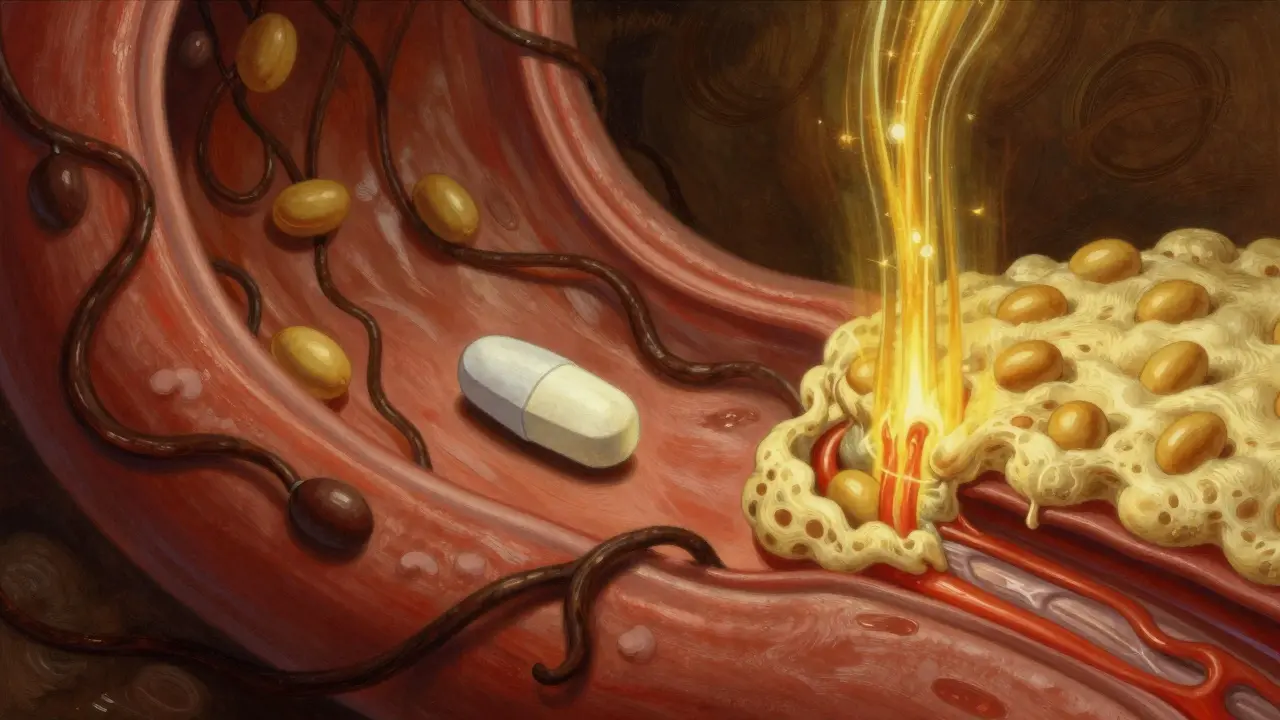
Soy doesn’t make your thyroid worse. It doesn’t cause hypothyroidism. But it can block your body from absorbing levothyroxine properly. The main culprits are soy isoflavones - compounds like genistein and daidzein - that bind to the medication in your gut. Think of it like a sponge soaking up water. The soy proteins act like that sponge, trapping the hormone before it can enter your bloodstream. Studies show this interference can reduce absorption by 9% to 30%, depending on how much soy you eat and when. One well-known case from 2006 involved a woman who had her thyroid removed and was taking 200 mcg of levothyroxine daily. Her TSH kept climbing because she was drinking soy protein shakes right after her pill. Once she spaced them out by four hours, her levels normalized. It’s not just supplements. Whole soy foods like tofu, edamame, soy milk, and tempeh all contain enough isoflavones to cause trouble. Even if you eat them in small amounts, doing it at the same time as your pill can throw off your dosing.How Much Does Soy Really Affect Your TSH?
You might wonder: is this a big deal? After all, you’ve seen people drink soy milk with their pills and seem fine. The answer is: it depends. A major review of 18 studies involving over 3,600 people found that soy only raised TSH levels by about 0.35 mIU/L on average - a tiny change in healthy people. But for someone already on thyroid medication, even a small rise can mean trouble. That’s because your doctor has carefully tuned your dose to keep your TSH between 0.5 and 2.5 mIU/L. A bump of 0.5 mIU/L might push you from ideal to borderline high. And if your TSH climbs above 4.5, you’re officially in subclinical hypothyroidism territory - meaning your body is struggling to get enough hormone. One Reddit user, HypoWarrior42, shared that after switching to daily soy milk with breakfast, their TSH jumped from 1.8 to 5.2 in just three months. Their endocrinologist had to increase their dose from 75 mcg to 100 mcg. That’s not rare. In a 2023 survey of 1,200 hypothyroid patients, 31% saw their TSH rise when they ate soy within an hour of taking their pill.How Long Should You Wait After Taking Levothyroxine?
The good news? You don’t need to avoid soy forever. You just need to separate it from your medication. The latest guidance from the Mayo Clinic (updated March 2023) says: wait at least two hours after taking levothyroxine before eating or drinking anything containing soy. For most adults, that’s enough. Some older guidelines said three or four hours, but new research from the European Thyroid Journal (January 2023) shows that two hours reduces interference to nearly zero - a TSH change of less than 0.1 mIU/L. Here’s the breakdown:- Best practice: Take levothyroxine on an empty stomach with a full glass of water, first thing in the morning.
- Wait 60 minutes before eating anything else - including coffee, fiber, or calcium-rich foods.
- Wait at least 2 hours before having soy milk, tofu, tempeh, edamame, or soy-based protein bars.
- For children and infants: Stick to 3-4 hours. Their systems absorb differently, and soy formula can require up to 30% higher doses of medication.
What About Soy Supplements?
Soy isoflavone pills and powders are more concentrated than whole foods. That means they can cause stronger interference - but also clear out faster. Most experts agree that two hours is usually enough to separate these from your medication. Still, if you’re taking high-dose supplements (over 50 mg of isoflavones daily), it’s safer to wait three hours. One big mistake? Taking soy supplements at the same time as your thyroid pill. I’ve seen patients do this thinking they’re being “natural” or “healthy.” But it’s like pouring salt on a wound. Your body can’t absorb the hormone, so your TSH climbs, your dose gets bumped up, and you end up taking more medication than you need - just because of timing.Other Foods That Interfere - And How Soy Compares
Soy isn’t the only food that messes with levothyroxine. Here’s how it stacks up against common offenders:| Interfering Substance | Average Absorption Reduction | Recommended Separation Time |
|---|---|---|
| Calcium supplements (carbonate) | 25-36% | 4 hours |
| Iron supplements | 20-30% | 4 hours |
| Soy products | 9-30% | 2-3 hours |
| Coffee | ~20% | 60 minutes |
| High-fiber foods (bran, psyllium) | 10-20% | 4 hours |
Real-Life Strategies That Work
So how do people actually make this work in real life? One common trick? Take your pill at bedtime. If you eat dinner at 7 p.m., you can take levothyroxine at 10 p.m. - two hours after your last meal, and long after any soy-containing dinner. No morning rush. No waiting. Just take it before bed and sleep through the wait. Another approach? Morning routine discipline. Get up, take your pill with water, wait 60 minutes, then have your coffee or oatmeal. Wait another 2-3 hours before your soy latte or tofu scramble. It’s a bit of a schedule, but once it’s routine, it becomes second nature. One patient I spoke to - a vegan in her 50s - switched from soy milk at breakfast to almond milk. She kept her tofu for lunch, three hours after her pill. Her TSH stayed at 1.4 for two years straight.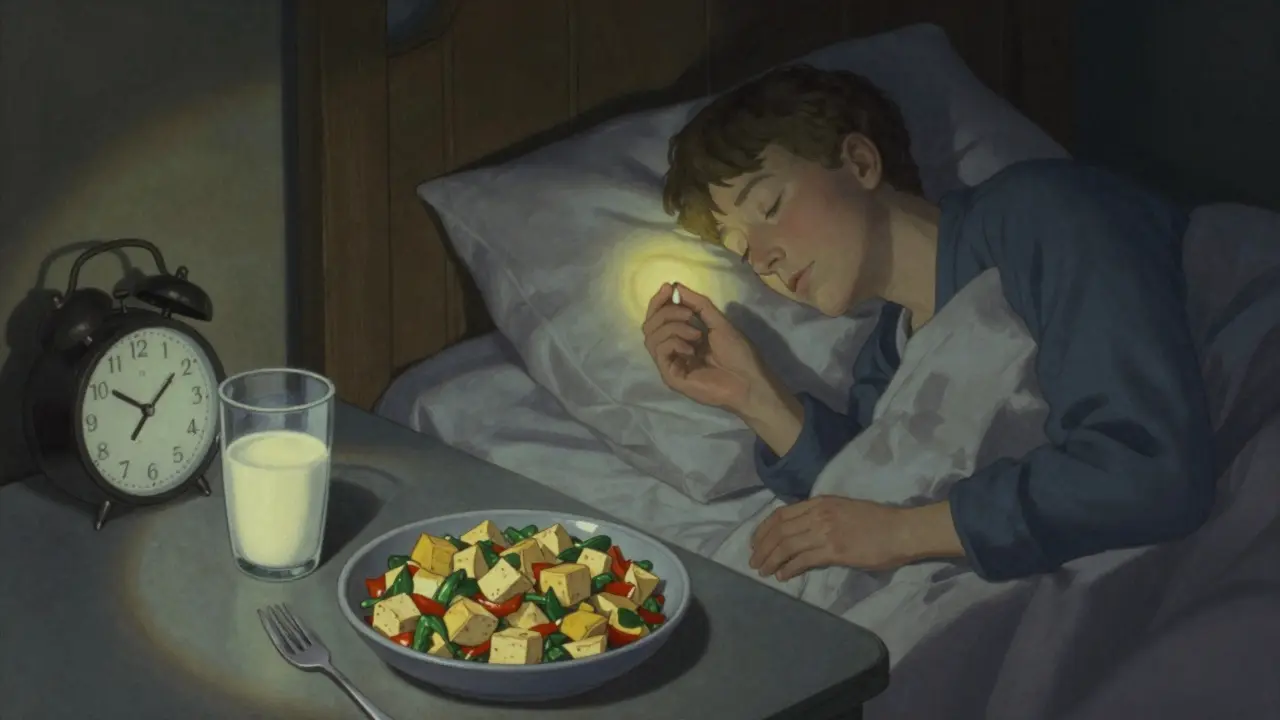
Who Needs to Be Extra Careful?
Not everyone needs to stress about soy. But these groups should pay close attention:- People newly diagnosed - your body is still adjusting. Even small absorption issues can delay stabilization.
- Those with subclinical hypothyroidism (TSH above 4.5) - soy can push you into full hypothyroidism.
- Infants and children on soy formula - their tiny bodies absorb medication differently. Dose adjustments are common.
- Vegetarians and vegans - if soy is your main protein source, you’re likely consuming it multiple times a day. Timing becomes critical.
What If You Forgot and Ate Soy Too Soon?
Mistakes happen. You had coffee with your pill. You ate a soy bar 45 minutes later. Your TSH might creep up slightly - but one slip won’t ruin everything. Don’t double your dose. Don’t skip your next pill. Just go back to your routine. Wait longer next time. If this happens often, talk to your doctor. They might suggest switching to a different time of day for your medication, or even consider a different formulation like Tirosint (a gel capsule that’s less affected by food).Final Takeaway: Timing Over Avoidance
You don’t need to quit soy. You don’t need to give up your favorite tofu bowl or soy latte. You just need to plan around your medication. Two hours is the magic number for most adults. Three hours if you’re unsure, or if you’re a child or have unstable thyroid levels. The goal isn’t perfection. It’s consistency. Take your pill the same way every day. Wait the same amount of time. Track your TSH. And if you notice your energy dropping, your weight creeping up, or your mood shifting - check your soy habits. Chances are, it’s not your thyroid failing. It’s just your timing.For millions of people on levothyroxine, soy isn’t the enemy. Poor timing is. Fix that, and you fix your health.
Cam Jane
January 7, 2026 AT 06:44I used to drink soy milk with my levothyroxine and wondered why I was so tired all the time. Switched to almond milk and waited 2 hours after my pill? Game changer. My energy’s back, my hair stopped falling out, and my TSH finally stabilized. No magic, just timing.
Also, if you’re vegan like me, try pea protein powder instead of soy-it’s just as good and doesn’t mess with your meds. Win-win.
Venkataramanan Viswanathan
January 8, 2026 AT 11:50It is a well-established fact that soy isoflavones exert a significant inhibitory effect on the intestinal absorption of levothyroxine through binding mechanisms involving glycoprotein transporters. The clinical implications are non-trivial, particularly in populations with suboptimal medication adherence or concurrent dietary supplementation. One must exercise rigorous temporal separation to maintain euthyroid status.
Molly McLane
January 10, 2026 AT 05:10For anyone new to this-don’t panic. You don’t have to give up tofu or soy sauce. I’m a full-time vegan and I eat soy three times a day. I just take my pill right when I wake up, wait an hour for coffee, then have oatmeal. Soy comes at lunch or dinner. It’s not hard. It’s just a habit.
And if you’re stressed about it? Talk to your endo. They’ve seen it all.
Beth Templeton
January 11, 2026 AT 10:22So you’re telling me the only reason my TSH is high is because I like my soy latte? Not my stress? Not my junk food? Not my 3 a.m. scrolling? Wow. What a revelation. Next you’ll tell me water is bad if you drink it 10 minutes after your pill.
Ryan Barr
January 11, 2026 AT 14:012 hours? Amateur. The real pros wait 4. If you’re not optimizing absorption to 99.9%, you’re just doing it wrong. Also, use Tirosint. Anything less is basic.
Dana Termini
January 13, 2026 AT 04:15My mom took levothyroxine for 15 years and never changed her soy habits. Her TSH was always fine. Maybe it’s not that universal? I get the science, but people aren’t lab rats. Some bodies just handle it better.
Wesley Pereira
January 14, 2026 AT 22:54soy is the new gluten lol. everyone’s like ‘oh my god my meds arent working’ and its always ‘you ate soy’ or ‘you drank coffee’ or ‘you touched grass too hard’. i’ve been on this med for 8 years and i eat tofu every day at lunch. my tsh is perfect. maybe your doc just dosed you wrong? just sayin.
Isaac Jules
January 16, 2026 AT 05:20Wow. Another ‘health guru’ pushing fear-based nutrition. Soy is a superfood. Levothyroxine is synthetic garbage. You’re telling people to avoid a plant-based protein because some lab-made hormone doesn’t absorb well? Pathetic. Your body doesn’t need that crap. Go natural. Eat seaweed. Stop poisoning yourself.
Amy Le
January 16, 2026 AT 15:52Pavan Vora
January 16, 2026 AT 15:58Actually, in India, we have been consuming soy products for generations, especially in the form of soy chunks and soy milk, and yet, hypothyroidism is not as prevalent as in the West-perhaps due to genetic differences, or perhaps due to the fact that we consume soy with spices like turmeric and black pepper, which may modulate absorption. Just a thought.
Stuart Shield
January 18, 2026 AT 08:47I used to think this was all hype until I started feeling like a zombie every afternoon. Then I remembered I’d been chugging soy lattes with my pill. One morning, I switched to tea and waited. Three days later, I actually woke up without hitting snooze five times. It’s not about fear. It’s about listening to your body. Sometimes the simplest fix is the one you ignore the longest.
Indra Triawan
January 18, 2026 AT 15:09I’ve been taking levothyroxine for 12 years and I still cry when I see soy milk. It reminds me of the time I gained 30 pounds and lost my job because I didn’t know. I’m not mad. I’m just… sad. And tired. Always tired.
Susan Arlene
January 19, 2026 AT 20:55i just take my pill at night now. no waiting. no stress. no soy drama. if it works, why overcomplicate it? my body doesn't care if it's morning or midnight. it just wants the hormone. and i want to sleep in.
Joann Absi
January 20, 2026 AT 18:37THEY DON’T WANT YOU TO KNOW THIS 😱
Soy is a corporate mind-control tool disguised as ‘plant-based protein’ 🌱💀
Big Pharma + Big Soy = Your thyroid is a pawn
They want you dependent on pills so you keep buying their soy milk and their meds
Wake up. Eat eggs. Live free. 🍳🔥
Ashley S
January 21, 2026 AT 19:05Why do people make this so hard? Just don’t eat soy. Problem solved. Why risk it? You want tofu? Eat it once a week. You want energy? Stop being lazy and take your pill right. That’s it.