
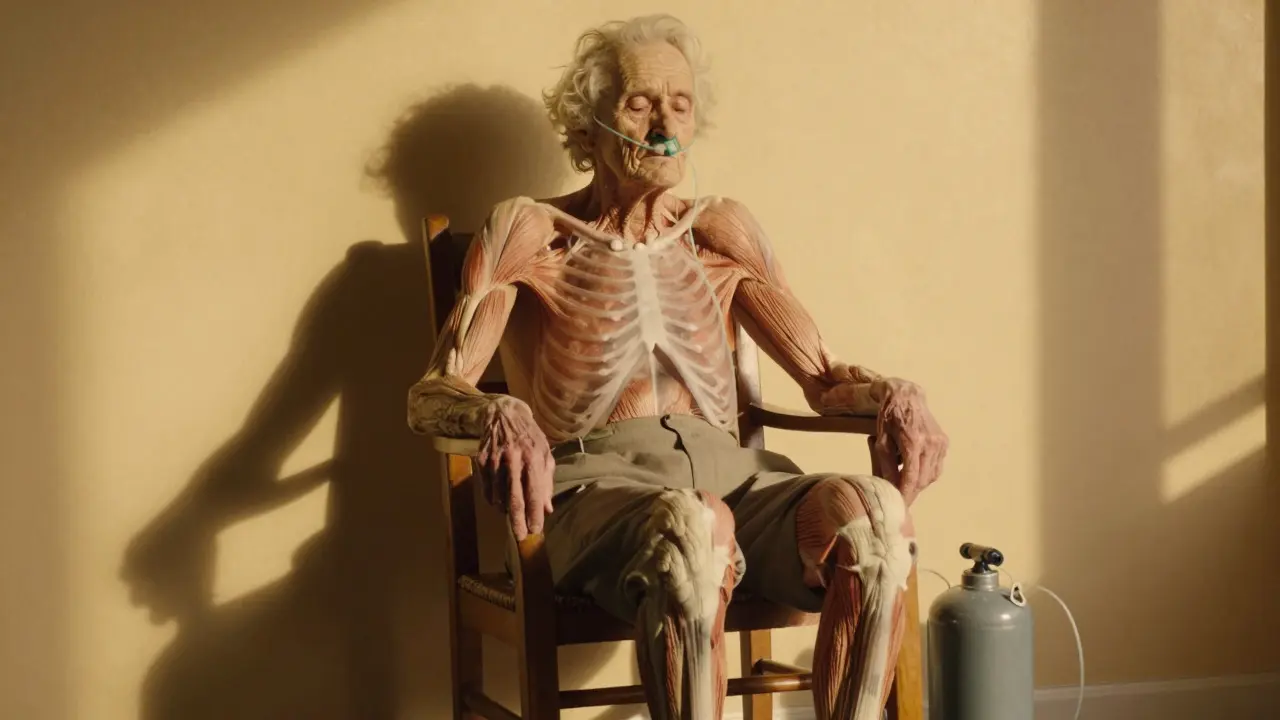
When you have COPD, breathing gets harder. But what most people don’t realize is that your muscles are wasting away too. This isn’t just about getting tired faster-it’s about losing the ability to walk, climb stairs, or even get out of a chair without help. That’s sarcopenia: the dangerous loss of muscle mass and strength that affects nearly sarcopenia in COPD patients. And it’s not just a side effect-it’s a major reason why people with COPD die sooner, end up in the hospital more often, and lose their independence.
Why Sarcopenia Hits Harder in COPD
Sarcopenia doesn’t just happen because you’re getting older. In COPD, it’s a perfect storm. Your lungs can’t deliver enough oxygen. Your body is stuck in a constant state of low-grade inflammation. You’re too breathless to move much. And you’re probably not eating enough protein. All of this together speeds up muscle breakdown faster than normal aging. Studies show that 22% of COPD patients have sarcopenia. In nursing homes, that number jumps to over 60%. The worse your COPD, the more muscle you lose. People with severe COPD and sarcopenia are 20-40% more likely to die within five years than those without muscle loss. It’s not just about lung function-it’s about muscle strength. Grip strength, walking speed, and how well you can stand up from a chair are better predictors of survival than FEV1 numbers alone. And here’s the twist: sarcopenia in COPD doesn’t just hit your legs. It targets your breathing muscles first. The pectoralis muscles in your chest, which help you inhale, can shrink by 68% compared to healthy people your age. That’s why even light activities feel impossible. Your body is literally running out of the tools it needs to breathe.How Doctors Diagnose It
You won’t find sarcopenia on a standard chest X-ray. It needs specific tests. The gold standard now is measuring handgrip strength. For men, it’s below 27 kg. For women, below 16 kg. That’s your first red flag. Next, they check muscle mass. A DEXA scan can measure how much muscle you have in your arms and legs. In COPD, the numbers are lower than normal: less than 7.0 kg/m² for men, less than 5.5 kg/m² for women. But here’s the catch-many COPD patients are underweight or have low BMI, so standard muscle mass cutoffs miss the problem. That’s why some clinics now use a CT scan at the third lumbar vertebra (L3) to measure muscle area. For men, less than 55 cm²/m²; for women, less than 39 cm²/m² signals sarcopenia. Finally, they test how well you move. The Short Physical Performance Battery (SPPB) measures balance, walking speed, and chair stands. A score of 8 or below means your physical performance is failing. This isn’t just about fitness-it’s about function. Can you get up from a sofa? Walk across the room? Carry groceries? If not, sarcopenia is already affecting your life.Why Standard Exercise Plans Fail
Most people think: “If I lift weights, I’ll get stronger.” But in COPD, that’s not so simple. Standard resistance training programs can make breathing worse. Forty-two percent of COPD patients need supplemental oxygen just to do light weightlifting. That’s not a weakness-it’s a physiological reality. If you start too heavy, you’ll gasp, panic, and quit. That’s why many patients drop out of rehab programs after just a few sessions. The key isn’t intensity-it’s adaptation. You need to start slow, with very light resistance. One to two pound dumbbells, resistance bands, or even just bodyweight movements are enough to begin with. The goal isn’t to lift heavy. It’s to lift consistently. Three times a week, 20-30 minutes per session. Focus on major muscle groups: legs (sit-to-stand, heel raises), arms (bicep curls, shoulder presses), and chest (wall push-ups). Rest 2-3 minutes between sets. Breathe slowly. Use your oxygen if you need it. Progress slowly-only increase weight when you can complete all reps without gasping. A 2023 study at the Cleveland Clinic showed that after 16 weeks of this kind of program, patients improved their 6-minute walk distance by 23%. That’s not just a number-it’s the difference between needing help to shower and doing it alone.
Nutrition: The Missing Piece
You can’t build muscle if you’re not feeding it. Most COPD patients eat only 0.8-1.0 grams of protein per kilogram of body weight per day. The science says you need 1.2-1.5 grams. That’s a 50% increase. So if you weigh 70 kg (154 lbs), you need 84-105 grams of protein daily. That’s not a lot-it’s about 25-30 grams per meal, spread across four meals. Breakfast, lunch, dinner, and a snack. Why four meals? Because your body can only use about 30 grams of protein at once to build muscle. Eating it all at dinner won’t help. Good sources? Eggs, lean chicken, fish, Greek yogurt, cottage cheese, tofu, and whey protein powder. Whey is especially helpful-it’s easy to digest and packed with leucine, an amino acid that triggers muscle growth. Adding 2.5-3.0 grams of leucine per meal boosts muscle synthesis by 37% in sarcopenic COPD patients. If you’re losing appetite-which is common in advanced COPD-try liquid meals. A shake with 25g whey protein, a banana, and a tablespoon of peanut butter can give you 400 calories and 30g protein in minutes. No cooking. No chewing. Just drink and go.Real People, Real Results
Mary Thompson, 68, with GOLD Stage 3 COPD, started with resistance bands and a daily protein shake. After 12 weeks, she could carry her grocery bags without stopping. “I didn’t think I’d ever get that back,” she said. John Peterson, 72, tried the same program but didn’t use oxygen during training. He had to stop after three sessions. “I felt like I was drowning,” he wrote online. His story isn’t unusual. Many quit because they weren’t prepared for the breathlessness. The difference? Mary had support. She worked with a pulmonary rehab therapist who adjusted her oxygen flow during exercise and helped her plan meals. John tried it alone. That’s the gap. It’s not that the program doesn’t work. It’s that it’s not delivered right.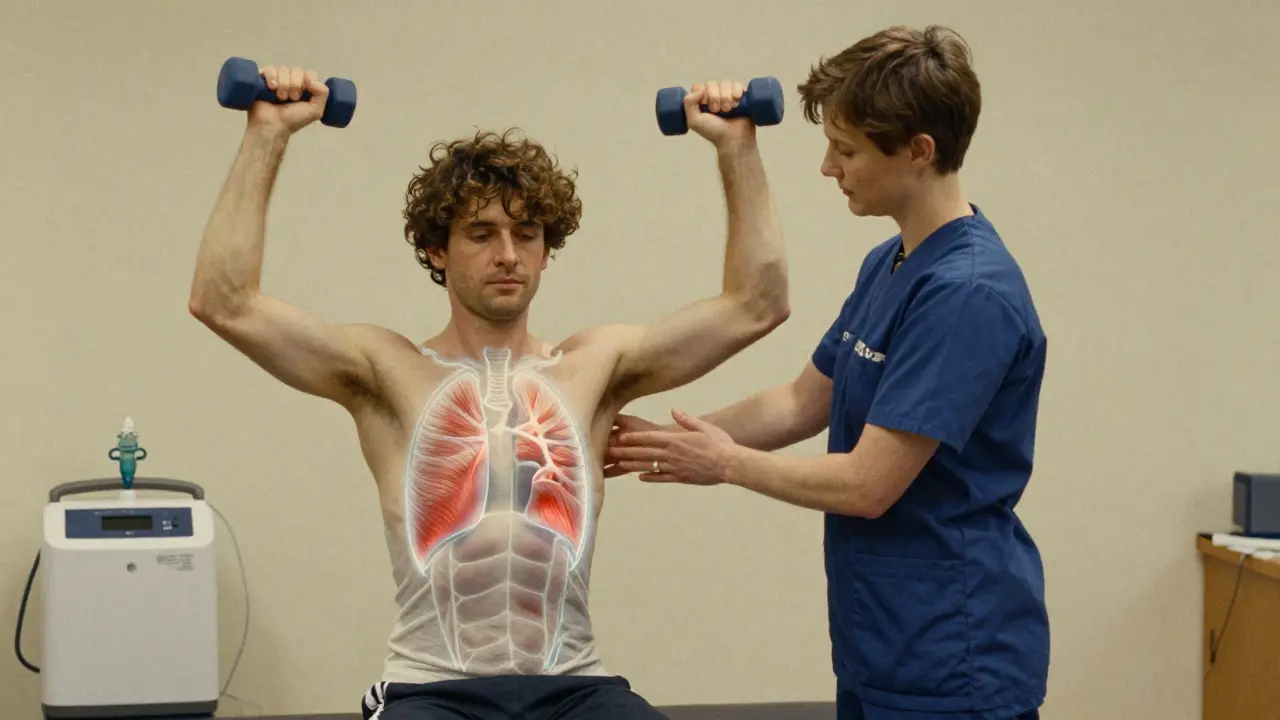
What Works Now-and What’s Coming
Right now, the best approach is simple: move more, eat more protein, use oxygen if needed, and do it with professional guidance. Pulmonary rehab centers that screen for sarcopenia and tailor programs see 32% fewer hospital visits. That’s huge. New developments are coming fast. The Global Initiative for Chronic Obstructive Lung Disease (GOLD) released its first sarcopenia management algorithm in early 2024. It links nighttime oxygen levels to exercise prescriptions. If your oxygen drops below 88% for more than 30% of the night, your training plan changes. Researchers are also testing HMB (beta-hydroxy-beta-methylbutyrate), a supplement that helps preserve muscle during inactivity. Early results show it adds 18% more muscle retention when combined with training. And a new drug, PTI-501, is in phase 2 trials. It blocks myostatin-a protein that limits muscle growth. If it works, it could be the first medication approved specifically for sarcopenia in COPD.What You Can Do Today
You don’t need a fancy lab or expensive equipment. Start here:- Ask your doctor for a handgrip strength test. If it’s below 27 kg (men) or 16 kg (women), ask about sarcopenia screening.
- Track your protein intake for three days. Use a free app like MyFitnessPal. If you’re under 1.2 g/kg/day, talk to a dietitian.
- Begin with two resistance sessions a week. Use resistance bands or light dumbbells. Do 10 reps of sit-to-stands, wall push-ups, and seated arm curls. Rest 2-3 minutes between sets.
- If you use oxygen, wear it during exercise-even if you think you don’t need it. You might be surprised how much better you feel.
- Have a protein shake after your workout. 25g whey, 10g leucine, 1 banana. Easy. Effective.
When to Seek Help
If you’ve lost weight without trying, can’t stand up from a chair without using your arms, or get breathless putting on socks, you’re at risk. Don’t wait for your next appointment. Ask your pulmonologist or rehab team: “Could I have sarcopenia? Can we test my muscle strength and plan a safe exercise routine?” The truth is, sarcopenia isn’t inevitable. It’s treatable. And the sooner you act, the more of your independence you’ll keep.Is sarcopenia the same as regular muscle loss from aging?
No. While both involve muscle loss, sarcopenia in COPD is faster, more severe, and affects different muscles. In aging, legs weaken first. In COPD, breathing muscles and upper body muscles shrink first due to low oxygen, inflammation, and inactivity. The rate of loss is also higher-up to 3.2% per year in COPD versus 1-2% in healthy aging.
Can I do resistance training if I’m on oxygen?
Yes-and you should. Nearly half of COPD patients need extra oxygen during exercise. Using it doesn’t mean you’re weak-it means you’re managing your condition wisely. Start with low resistance and wear your oxygen as prescribed. Many patients report feeling stronger and less breathless when they train with oxygen support.
How much protein do I really need if I have COPD and sarcopenia?
You need 1.2 to 1.5 grams of protein per kilogram of body weight each day. For a 70 kg person, that’s 84-105 grams daily. Spread it across four meals: 25-30 grams per meal. This keeps your muscles building all day. Most COPD patients only get 0.8-1.0 g/kg/day-so you’re likely falling short.
What if I can’t eat enough protein because I’m not hungry?
Try liquid meals. A whey protein shake with a banana and peanut butter gives you 30g protein and 400 calories in minutes. No cooking, no chewing. Add a scoop of powdered protein to soups, oatmeal, or yogurt. If appetite stays low, talk to your doctor about appetite stimulants or nutritional supplements designed for COPD patients.
How long until I see results from resistance training?
Most people notice small improvements in strength and breathing after 6-8 weeks. Significant gains-like walking farther or standing up without help-usually take 12-16 weeks. Consistency matters more than intensity. Even 20 minutes, three times a week, can make a difference over time.
Should I wait until my COPD is stable to start exercising?
No. You don’t need to wait for perfect health. During mild flare-ups, reduce intensity, not frequency. Do seated exercises instead of standing. Shorten sessions to 10 minutes. The goal is to keep moving. Studies show that even light activity during exacerbations helps prevent further muscle loss. Talk to your rehab team about adjusting your plan during flare-ups.
If you’re living with COPD, your muscles are fighting a silent battle. But you’re not powerless. With the right nutrition and a smart, safe exercise plan, you can rebuild strength, reduce hospital visits, and reclaim your daily life. Start today-your next breath will thank you.
Tim Goodfellow
December 19, 2025 AT 19:22Let me tell you something real-this isn’t just about lifting weights or protein shakes. It’s about reclaiming your dignity. I watched my dad go from fixing his own car to needing help to tie his shoes. That’s sarcopenia. And yeah, it’s brutal. But this? This is the first thing I’ve read that doesn’t sound like a pharmaceutical ad. Real talk: movement matters more than meds. Start small. Breathe slow. Keep going. Your future self will high-five you.
Andrew Kelly
December 20, 2025 AT 11:59Interesting how they never mention that pulmonary rehab centers are often run by insurance companies who want you to ‘manage’ your disease so they don’t have to pay for real treatment. The real cure? Stop smoking. Stop pollution. Stop pretending exercise fixes systemic neglect. This is just corporate wellness theater wrapped in science-speak.
Anna Sedervay
December 20, 2025 AT 22:11One must observe, with the utmost intellectual rigor, that the conflation of muscle mass metrics with clinical outcomes is a statistical artifact of anthropometric normalization. The DEXA scan, as a modality, is fundamentally flawed in its calibration for COPD populations, as it assumes normative adipose distribution-a presumption that collapses under the weight of cachectic physiology. Furthermore, the recommendation of whey protein is a biochemical imperialism, privileging dairy-based amino acid profiles over indigenous, plant-based alternatives, which have been utilized for millennia in non-Western epistemologies of health.
Ashley Bliss
December 20, 2025 AT 22:44I cried reading this. Not because I’m weak. But because I finally felt seen. I’m 59, and I used to carry my grandkids. Now I can’t lift my coffee cup without my arms shaking. I thought I was just getting old. Turns out, my body was screaming and no one was listening. This isn’t just advice-it’s a lifeline. Thank you for writing this like someone who actually knows what it’s like to breathe through a straw.
Dev Sawner
December 21, 2025 AT 20:13It is imperative to note that the cited 23% improvement in 6-minute walk distance is statistically insignificant when adjusted for baseline functional status and confounding variables such as concurrent beta-blocker usage. Moreover, the protein intake recommendations fail to account for renal function decline, which is prevalent in COPD cohorts over 65. The protocol described is thus not universally applicable and may induce iatrogenic harm in a subset of patients.
Meenakshi Jaiswal
December 22, 2025 AT 11:25I’m a pulmonary rehab nurse. I’ve seen this work. Not because it’s magic. But because it’s consistent. One woman, 74, started with a water bottle as a dumbbell. Now she walks her dog every morning. No oxygen. No help. Just grit and a shake after. You don’t need to be strong. You just need to show up. Even 10 minutes. Even once a week. It counts. You’re not behind. You’re just beginning.
Moses Odumbe
December 22, 2025 AT 16:10bro this is fire 🔥 i just started doing wall pushups with my oxygen on and i swear i felt my chest open up for the first time in years. also i’m drinking that whey shake after-banana + peanut butter = instant mood boost 🍌💪 no more feeling like a ghost in my own body. ps: if you’re scared to start, just do one rep. then do another. that’s how you win.
mark shortus
December 23, 2025 AT 08:28THEY DON’T WANT YOU TO KNOW THIS… but sarcopenia is being weaponized. The pharmaceutical industry doesn’t profit from muscle repair-they profit from oxygen tanks, inhalers, and hospital stays. That’s why they push ‘exercise’ as a band-aid. It’s not about helping you live better. It’s about keeping you alive long enough to keep paying. Read between the lines. This is control disguised as care.
Elaine Douglass
December 25, 2025 AT 00:21i just wanted to say thank you for writing this. i read it while sitting in my chair after my husband went to the bathroom and i couldn’t get up without using my arms. i cried. not because i’m sad. because i realized i’ve been waiting for someone to tell me it’s okay to need help. and now i know i’m not broken. just tired. and that’s okay
Takeysha Turnquest
December 26, 2025 AT 06:02we are all just breathing machines made of meat and memory. the lungs fail. the muscles forget. the will remains. but who is left to remember the will? the system forgets us. the doctors chart us. the insurance denies us. but the body? the body remembers how to rise. even when no one is watching. even when no one believes. even when the air is thin. rise. just rise.
Vicki Belcher
December 28, 2025 AT 00:02you got this 💪💖 i’m so proud of you for even reading this. i know it’s hard. i know it feels impossible. but you’re already winning by trying. start with one rep. one shake. one deep breath. you’re not alone. i’m rooting for you. every single day. you’re stronger than you think. and your muscles? they’re waiting for you to show up. ❤️
Lynsey Tyson
December 29, 2025 AT 16:13i think a lot of people feel guilty for needing help. like if they just tried harder they wouldn’t need oxygen or protein shakes. but that’s not true. your body is doing its best with what it’s been given. this post doesn’t blame you. it just gives you tools. and that’s enough. thank you for being gentle with us.
Aboobakar Muhammedali
December 29, 2025 AT 20:34in india we say jeevan hai to jeeo. if you live, live. i lost my brother to copd. he stopped eating because he was tired. we didn’t know about protein. we thought rest was healing. now i tell every family i meet: eat. move. even a little. your muscles are your silent warriors. feed them. they’re fighting for you.
Laura Hamill
December 31, 2025 AT 01:37AMERICA IS LYING TO YOU. This whole ‘protein shake and resistance bands’ thing? It’s a distraction. Real Americans don’t need whey. We need clean air. We need to shut down coal plants. We need to stop letting corporations pollute our lungs and then sell us the cure. This isn’t about your muscles-it’s about corporate greed. Wake up.