

When your body’s hormone system goes off track, it’s rarely because one thing is broken. More often, it’s because a tiny tumor-so small you’d need an MRI to see it-is quietly throwing everything out of balance. That’s the reality for people with prolactinomas, the most common type of pituitary adenoma. These aren’t cancerous, but they’re powerful. They produce too much prolactin, a hormone meant for breastfeeding, and end up messing with fertility, sex drive, energy, and even your vision if they grow large enough.
What Exactly Is a Pituitary Adenoma?
The pituitary gland sits at the base of your brain, no bigger than a pea. But it’s the master controller of your hormones. It tells your thyroid how much hormone to make, tells your adrenal glands when to release stress chemicals, and tells your ovaries or testes when to produce sex hormones. A pituitary adenoma is a a non-cancerous growth that forms in this gland. About 1 in 10 people have one, but most never know it because they don’t cause symptoms.
What makes prolactinomas different is that they’re active. They don’t just sit there-they pump out extra prolactin. Normal levels are under 20 ng/mL for women and under 15 ng/mL for men. In prolactinomas, levels can hit 200, 500, even 5,000 ng/mL. That’s not a small bump-it’s a flood.
How Prolactinomas Disrupt Your Body
Too much prolactin doesn’t just cause milk production. It shuts down the rest of your reproductive system. In women, this means missed periods (amenorrhea), trouble getting pregnant, and sometimes even milk leaking from the breasts when they’re not nursing. About 95% of women with untreated prolactinomas experience one or both of these. In men, it’s less obvious but just as damaging: low testosterone, reduced sex drive, erectile dysfunction, and sometimes breast tenderness or enlargement.
But it’s not just about sex hormones. If the tumor grows past 1 cm (a macroadenoma), it starts pressing on nearby structures. The optic nerves sit right above the pituitary. When squished, they cause blind spots in your peripheral vision-like looking through a tunnel. That’s why anyone with a tumor this size needs an eye exam right away.
Diagnosis: Blood, Scan, and Vision Test
You won’t feel a pituitary adenoma. You won’t see it. So how do you find it? Three steps:
- Serum prolactin test: If your level is over 150 ng/mL, there’s a 95% chance it’s a prolactinoma. Levels under 100 usually mean a smaller tumor. But don’t jump to conclusions-stress, pregnancy, certain medications, and even nipple stimulation can raise prolactin temporarily. Your doctor will check again after you’ve rested.
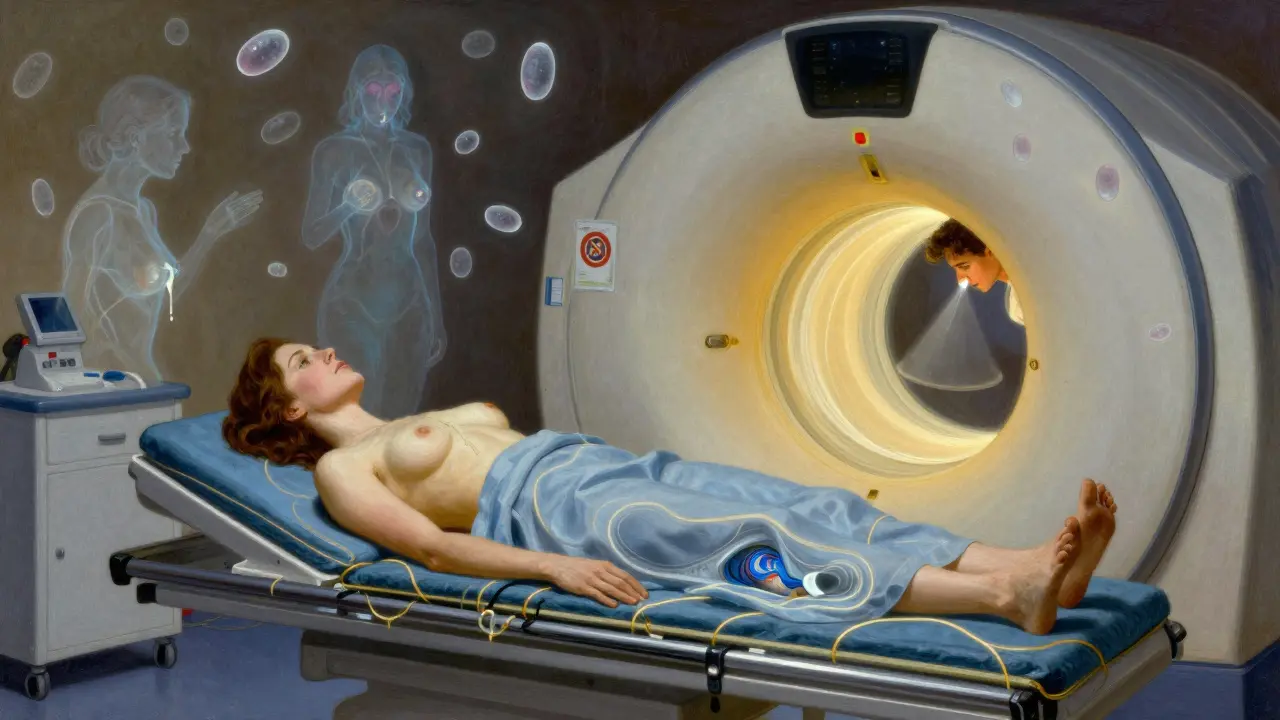
- Pituitary MRI: A 3mm-thick slice MRI is the gold standard. It shows size, shape, and whether the tumor is invading nearby bone or the cavernous sinus (a complex area packed with nerves and blood vessels).
- Visual field testing: If the tumor is over 1 cm, you need this. It maps your peripheral vision to catch early damage before it’s permanent.
There’s no single symptom that screams "prolactinoma." It’s the combination-low libido, irregular periods, unexplained milk, and vision changes-that points to it.
Treatment: Medication First, Always
For decades, surgery was the go-to. Now? Cabergoline is the undisputed first choice. It’s a dopamine agonist-meaning it tricks your brain into thinking there’s enough dopamine, which tells the pituitary to stop making prolactin. The results are dramatic.
For microadenomas (under 1 cm), 80-90% of patients normalize prolactin within 3 months. Tumors shrink by 70% or more. For macroadenomas, it’s still 70% effective. One case from Mayo Clinic followed a woman with a 2.4 cm tumor and prolactin at 5,200 ng/mL. After 6 months on cabergoline 1 mg twice weekly, her levels dropped to 18 ng/mL. The tumor was half its original size.
Most people start with 0.25 mg twice a week. If prolactin doesn’t drop after 4-6 weeks, the dose is slowly increased. Side effects? Nausea and dizziness, especially at first. But they usually fade. Only 18% of patients stop cabergoline because of side effects-compared to 32% who quit bromocriptine, the older drug.
When Surgery Is Needed
Not everyone responds to pills. Some can’t tolerate them. Others have tumors that are pressing on the optic nerve and need fast relief. That’s when surgery comes in.
The standard is endoscopic transsphenoidal surgery. A surgeon goes through the nose, not the skull. No scars on the face. Hospital stay? Usually 3-5 days. Recovery? Most people feel back to normal in 3-6 weeks.
Success rates depend on size. For microadenomas, cure rates are 85-90%. For macroadenomas? Only 50-60%. And even when the tumor is removed, it can come back. About 25-30% of macroadenoma patients see a return within 5 years.
Surgery risks include a leak of spinal fluid (2-5%), temporary diabetes insipidus (5-10%), and in rare cases, pituitary apoplexy (bleeding into the tumor). But for people with vision loss or who can’t take meds, the trade-off is worth it.

Radiation: The Slow Option
Radiation isn’t used first. It’s slow. It takes 2-5 years to lower prolactin. But it’s useful when meds and surgery fail-or when the tumor is too close to critical nerves to remove safely.
There are three types:
- Fractionated radiation: 45-54 Gy over 5-6 weeks. Effective, but damages healthy tissue over time.
- Gamma Knife: A single high-dose beam. Targets the tumor precisely. 95% control at 5 years. Only 1-2% risk of optic nerve damage.
- Proton therapy: Newer, even more precise. Used in complex cases.
Downside? Half of patients develop hypopituitarism-meaning the gland stops making other hormones too. That means lifelong replacement therapy for cortisol, thyroid hormone, or sex hormones.
Long-Term Management: It’s Not a One-Time Fix
Prolactinomas don’t just disappear. Even after successful treatment, you need monitoring.
If you’re on cabergoline, you’ll get prolactin checked every 3 months at first. Once stable, once a year. Missing a dose? Prolactin can rebound in 72 hours. That’s why adherence matters.
If you had surgery, you’ll need regular MRI scans. Tumors can regrow silently. And if you had radiation, you’ll need hormone tests every year for life-you might lose the ability to make your own.
And here’s something few talk about: Cabergoline can affect heart valves. At doses over 2 mg per week for more than 3 years, there’s a 2-7% risk of valve regurgitation. That’s why the European Society of Endocrinology recommends an echocardiogram every 2 years if you’re on high doses long-term.
What’s Next? The Future of Treatment
Research is moving fast. In 2023, the FDA approved paltusotine for acromegaly-a similar pituitary disorder-and trials for prolactinomas are starting. Scientists are also exploring CRISPR gene editing to fix mutations like MEN1 that drive tumor growth. AI is being used to plan surgeries with surgical robots that can navigate around nerves in real time.
But the biggest shift? Personalized medicine. We’re starting to identify tumor types by their genetic markers-not just size or hormone level. A tumor with a USP8 mutation might respond better to certain drugs. A GNAS mutation might be more aggressive. In the next 5 years, your treatment won’t just be based on your prolactin number. It’ll be based on your tumor’s DNA.
For now, though, the message is simple: If you have unexplained infertility, low libido, or vision changes, get tested. A small tumor can be fixed with a pill. And for most people, that’s all it takes.
Can prolactinomas cause infertility?
Yes. High prolactin suppresses the hormones that trigger ovulation in women and sperm production in men. In women, about 95% experience missed periods or trouble conceiving. In men, 80% have low testosterone and reduced fertility. Normalizing prolactin with medication often restores fertility within months.
Is cabergoline safe long-term?
For most people, yes. Side effects like nausea and dizziness usually fade. But at doses over 2 mg per week for more than 3 years, there’s a small risk of heart valve thickening. That’s why doctors recommend an echocardiogram every 2 years if you’re on long-term, high-dose treatment. Always report any new shortness of breath or swelling in your legs.
Can I stop taking cabergoline once my prolactin is normal?
Rarely. About 70% of patients need to stay on medication indefinitely. Stopping even for a few weeks can cause prolactin to spike again and the tumor to regrow. Some people with very small tumors may be able to taper off under close monitoring-but only if prolactin stays normal for 2+ years. Never stop without your doctor’s guidance.
Do all pituitary adenomas need treatment?
No. About 90% of pituitary adenomas are non-functional-they don’t make hormones-and cause no symptoms. These are often just watched with periodic MRI scans. Treatment is only needed if the tumor grows, presses on nerves, or starts overproducing hormones like prolactin, cortisol, or growth hormone.
Why is MRI done with 3mm slices?
The pituitary gland is tiny-only about 1 cm across. Standard MRI slices (5-10 mm) can miss small tumors. A 3mm slice gives a much clearer view of the gland’s structure, helping doctors spot microadenomas under 5 mm and determine if the tumor is invading nearby tissue. This precision changes treatment decisions.
What’s the difference between microadenoma and macroadenoma?
It’s all about size. A microadenoma is under 1 cm and usually doesn’t press on nerves. It rarely causes vision problems. A macroadenoma is over 1 cm and can compress the optic nerves, leading to vision loss. It’s also more likely to affect other pituitary hormones and harder to treat with surgery alone. About 80% of pituitary adenomas are microadenomas.
Dominic Punch
February 26, 2026 AT 08:49Valerie Letourneau
February 26, 2026 AT 17:37Khaya Street
February 27, 2026 AT 07:52Christina VanOsdol
February 27, 2026 AT 14:35Brooke Exley
February 28, 2026 AT 16:36Alfred Noble
March 1, 2026 AT 10:16Matthew Brooker
March 3, 2026 AT 04:45Emily Wolff
March 4, 2026 AT 22:11Lou Suito
March 5, 2026 AT 12:08Joseph Cantu
March 5, 2026 AT 22:21