
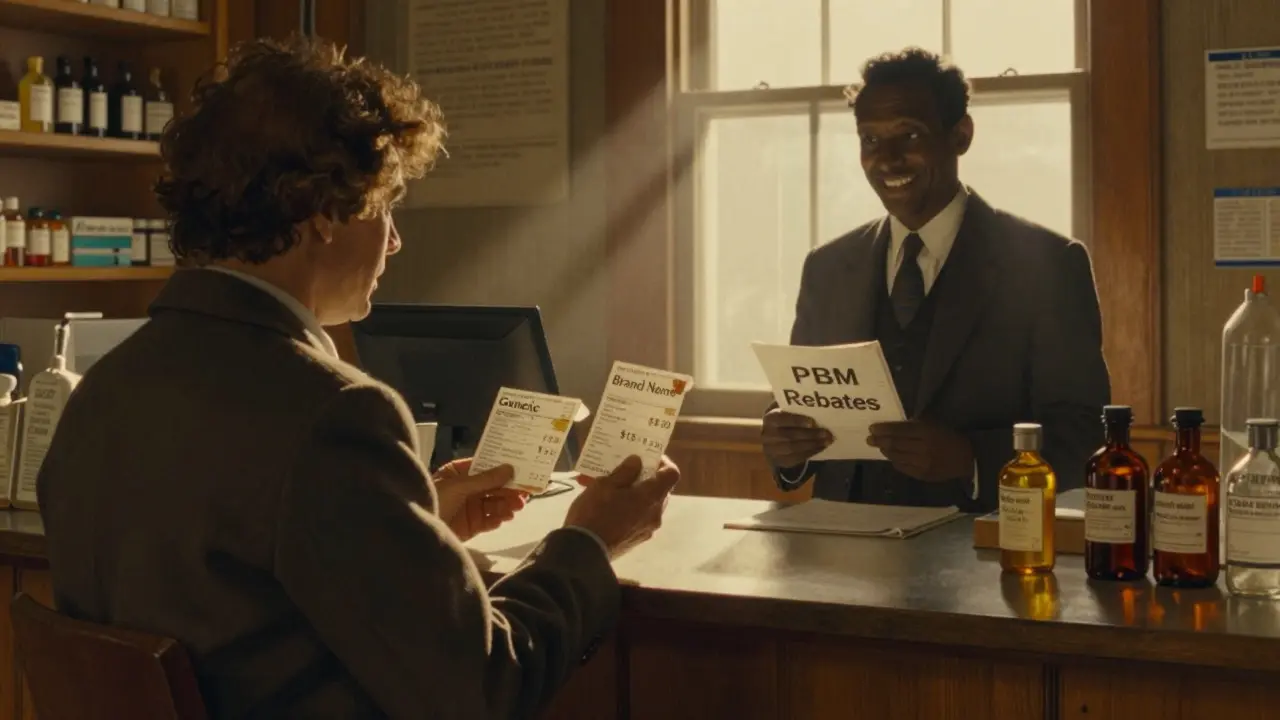
When you pick up a prescription, the price on the receipt doesn’t tell the whole story. Two people might be filling the same drug-one with a generic, the other with a brand-name version-but their out-of-pocket costs could be wildly different. Why? It’s not just about which drug is cheaper. It’s about how your insurance works, what kind of plan you have, and even which pharmacy you use. And in some cases, the generic drug ends up costing more.
Generics aren’t just cheaper-they’re the same drug
You’ve probably heard it before: generics are just as good as brand-name drugs. That’s not marketing fluff. The U.S. Food and Drug Administration (FDA) requires generic drugs to contain the exact same active ingredients as their brand-name equivalents and prove they work the same way in the body. That means if you’re taking clopidogrel bisulfate (a generic for Plavix) or omeprazole (generic for Prilosec), your body gets the same medicine, just without the brand name on the bottle.
The difference? Price. On average, generics cost 80-85% less than brand-name versions. In the U.S., 90% of all prescriptions filled are for generics. Yet, despite that overwhelming dominance, brand-name drugs still account for nearly 75% of total prescription spending. Why? Because when you pay for a brand-name drug, you’re often paying for patents, marketing, and corporate profits-not better medicine.
How insurance turns simple pricing into a maze
Here’s where things get confusing. If generics are so much cheaper, why do some people pay more for them? It all depends on your insurance plan’s design.
There are two main ways insurers structure drug costs: copayments and coinsurance.
- Copayments are fixed amounts-say, $10 or $20-no matter what the drug costs. If your plan has a $15 copay for generics, you pay $15 even if the drug costs $50 or $500. That means when the manufacturer raises the list price, you don’t feel it.
- Coinsurance means you pay a percentage of the drug’s price. If your plan says you pay 30% of the cost, and the drug jumps from $100 to $120, your payment goes from $30 to $36. That’s direct exposure to price hikes.
A 2021 study in JAMA Network Open found that about half of commercially insured patients were shielded from rising drug prices because of fixed copays. The other half? They got hit with every price increase. And those increases? Between 2017 and 2019, the median list price for brand-name drugs rose by 16.7% after adjusting for inflation. That’s not inflation-that’s a tax on people with coinsurance plans.
The Medicare Part D trap: when generics cost more
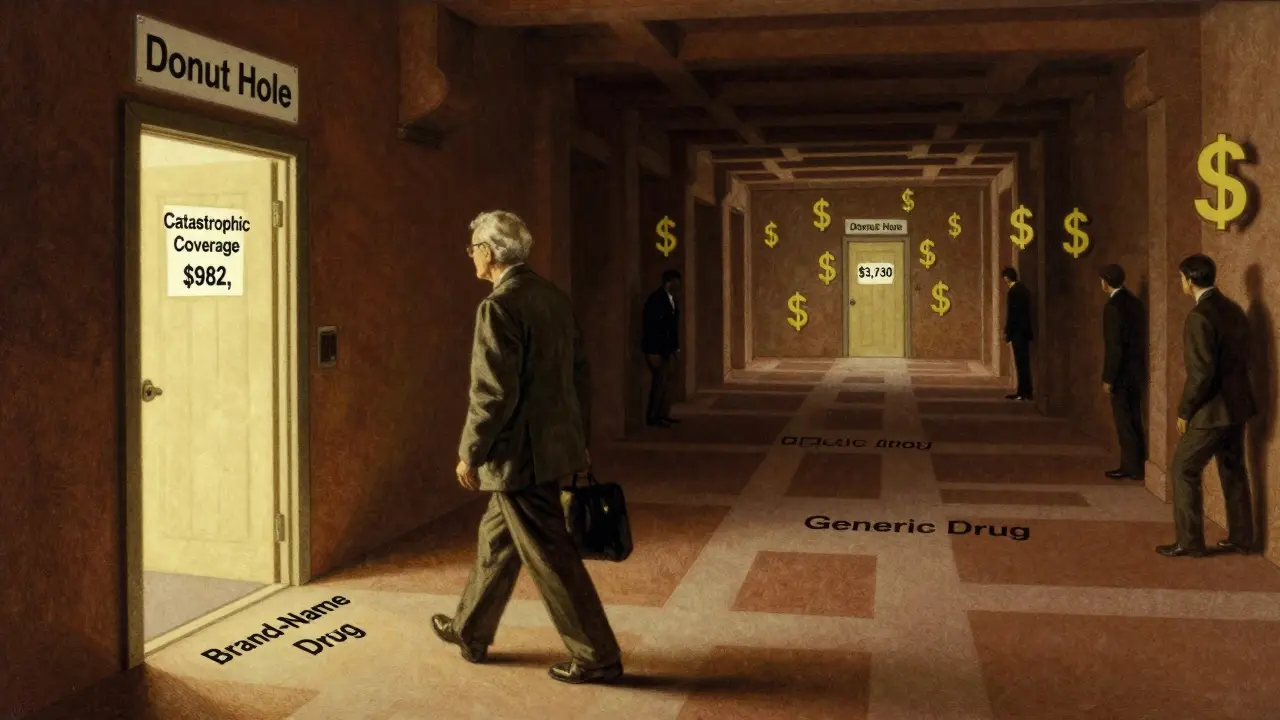
If you’re on Medicare Part D, the system gets even stranger. In this program, there’s a gap in coverage called the “donut hole.” Once you and your plan spend a certain amount on drugs, you enter this gap and pay more out of pocket-until you hit catastrophic coverage.
Here’s the twist: brand-name drug manufacturers are required to give discounts during the donut hole. Those discounts count toward your out-of-pocket spending. Generic manufacturers? They don’t have to.
That means if you’re taking a brand-name drug, you might hit catastrophic coverage-where you pay only 5% of the drug’s cost-after spending $982. If you’re on a generic? You have to spend $3,730. That’s 279% more before you get the same protection.
This isn’t a bug-it’s how the rules were written. In 2020, the threshold for catastrophic coverage jumped from $5,100 to $6,350. That made the gap even harder to escape for generic users. And while policy experts have called for fixing this, Congress has yet to act.
Why you might pay more for a generic-even with insurance
Even if you’re not on Medicare, the system can still work against you. A 2022 analysis from the Schaeffer Center at USC found that patients overpay for generics by 13-20% because of hidden fees in the supply chain. These aren’t drug costs-they’re profits for pharmacy benefit managers (PBMs), insurers, and middlemen who negotiate rebates behind closed doors.
Here’s how it works: A drug might cost $10 to make. The manufacturer lists it at $100. The PBM negotiates a $70 rebate. Your insurance pays $30, and you pay $20. But the system never tells you the real cost. You think you’re getting a deal, but you’re actually paying more than you should.
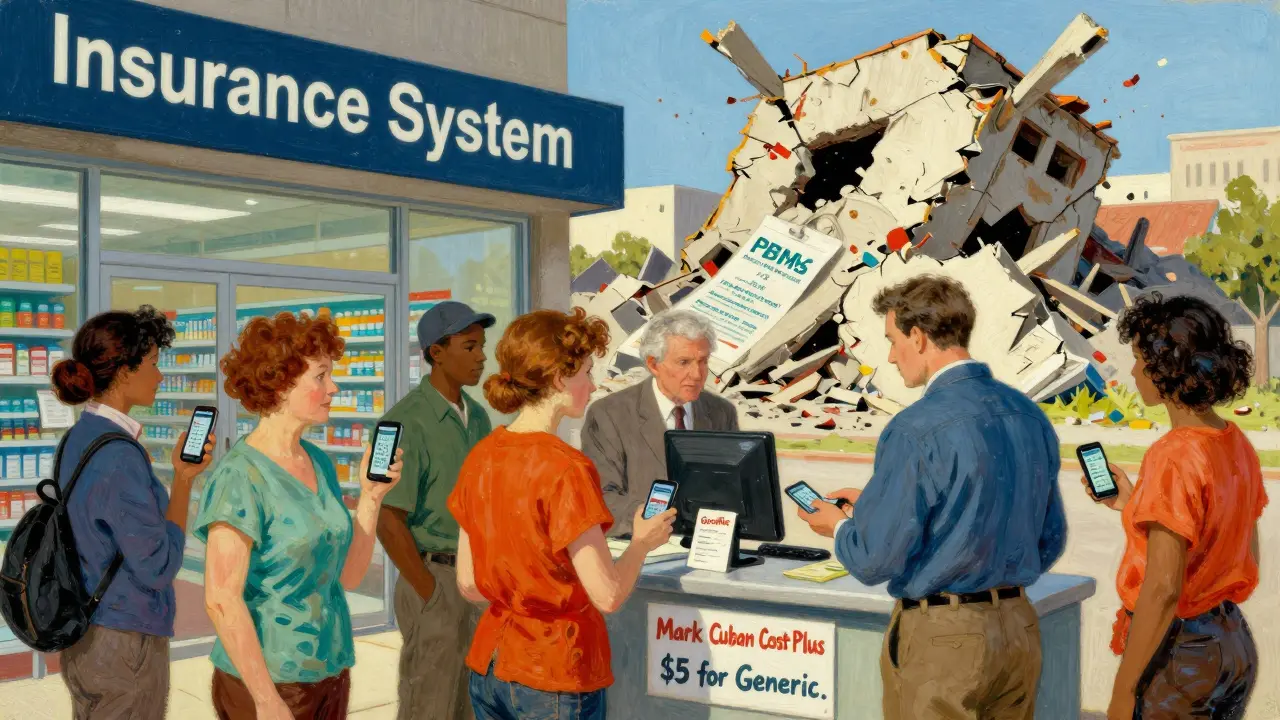
And it’s worse for expensive generics. A 2024 study found that for 11.8% of generic prescriptions, patients saved money-on average $4.96-by paying cash instead of using insurance. That’s because cash prices at pharmacies like Mark Cuban Cost Plus Drug Company or Blueberry Pharmacy are often lower than the negotiated insurance rate.
What you can do: practical tips to save
You don’t have to accept whatever price you’re given. Here’s how to take control:
- Ask if a generic is available. Your doctor can write "do not substitute" if they believe the brand is necessary-but if they don’t, you’re entitled to the generic.
- Compare prices. Use tools like GoodRx or check cash prices at pharmacies. Sometimes, paying cash is cheaper than using insurance-even for generics.
- Know your plan. Check if you’re on a copay or coinsurance plan. If you’re on coinsurance, ask if switching to a lower-tier drug could help.
- Ask about patient assistance programs. Many brand-name manufacturers offer discounts if you qualify based on income.
- Don’t assume generics are always cheaper. Especially with Medicare Part D, a high-priced generic could cost you more than a brand-name drug.
And if you’re uninsured? You’re not stuck. Cash prices at transparent pharmacies can cut your drug costs by half or more. In 2020, 97% of cash prescriptions were for generics. That’s not a coincidence-it’s a signal.
The big picture: why this system doesn’t make sense
At its core, the U.S. drug pricing system rewards complexity over fairness. Generics are safe, effective, and should be affordable. But the way rebates, discounts, and insurance tiers are structured means patients pay more-not less-for the cheaper option.
Between 2010 and 2020, generics saved the U.S. healthcare system nearly $2.4 trillion. Yet, patients still pay billions more than they should because of opaque pricing and profit-driven middlemen.
Dr. Eric D’Agostino, a pharmacist at Brown University Health, puts it simply: "Generic medications are just as safe and effective as branded medications and will most likely cost less money out of pocket." But "most likely" isn’t good enough. The system needs to make "always" the rule.
Are generic drugs really as effective as brand-name drugs?
Yes. The FDA requires generic drugs to have the same active ingredients, strength, dosage form, and route of administration as their brand-name counterparts. They must also prove they are bioequivalent-meaning they work the same way in your body. Differences in inactive ingredients (like fillers or dyes) don’t affect how the drug works. Millions of people take generics every day with the same results as brand-name drugs.
Why do some people pay more for generics than brands?
This mainly happens with Medicare Part D. Brand-name manufacturers are required to give discounts during the "donut hole" coverage gap, and those discounts count toward your out-of-pocket spending. Generic manufacturers aren’t required to do this. So, even if a generic drug costs less, you might have to spend far more before reaching catastrophic coverage-where your costs drop to 5%. A 2019 study found Medicare Part D users paid $3,730 out of pocket to reach catastrophic coverage with generics, versus $982 with brand-name drugs.
Should I always choose the generic version?
In most cases, yes. Generics are equally safe and effective. But if your doctor writes "do not substitute" on your prescription, they believe the brand is necessary for your condition. Always ask why-sometimes it’s habit, not medical need. Also, check your insurance plan: if you’re on coinsurance, a brand-name drug might cost more than a generic with a fixed copay. Compare prices using tools like GoodRx before deciding.
Can I save money by paying cash for generics?
Yes-especially if you’re on a high-deductible plan or Medicare Part D. A 2024 study found that 11.8% of generic prescriptions cost less when paid in cash than when billed through insurance. Pharmacies like Mark Cuban Cost Plus Drug Company and Blueberry Pharmacy offer transparent, low cash prices because they cut out the middlemen. For uninsured patients, this can mean savings of 50% or more.
Why do generic drug prices vary so much between pharmacies?
Because drug pricing is a mess. Pharmacy benefit managers (PBMs) negotiate secret rebates with manufacturers, and those deals determine what your insurance pays. But what you pay out of pocket depends on your plan’s structure. Cash prices, however, reflect the actual wholesale cost minus a small markup. That’s why paying cash at a transparent pharmacy can be cheaper than using insurance-even for generics.
lela izzani
February 24, 2026 AT 16:42Had no idea generics could cost more than brands under Medicare. I’m on Part D and just assumed the generic was cheaper. Turns out I was paying $42 for my generic lisinopril while the brand was $38 cash at my local pharmacy. GoodRx saved me. Now I pay $12 cash every month. No insurance needed.
Also, PBMs are the real villains here. They’re not just middlemen-they’re profit-siphoning black boxes. Why can’t we just have transparent pricing? It’s 2024, not 1994.
Vanessa Drummond
February 24, 2026 AT 21:09This system is a joke. I pay $80 for my generic thyroid med because my insurance says so. Meanwhile, the cash price is $14. I’m not even mad-I’m just done. Why do we tolerate this? Because we’re too tired to fight it. And the companies know it. They’re laughing all the way to the bank while we ration pills.
Nick Hamby
February 25, 2026 AT 17:34It is, in many respects, a profound moral failure of our healthcare architecture that the most cost-effective therapeutic options are systematically disadvantaged by structural incentives. The FDA’s equivalence standard is scientifically sound, yet the economic framework surrounding pharmaceutical distribution privileges opacity over accessibility.
One might reasonably ask: if a drug is bioequivalent, why does its price not reflect its intrinsic value? The answer lies not in pharmacology, but in rent-seeking behavior by intermediaries who extract value without adding utility. The PBM model, in particular, functions as a regulatory capture mechanism disguised as negotiation.
Moreover, the Medicare Part D donut hole asymmetry is not merely a flaw-it is a deliberate design feature that incentivizes patient suffering as a cost-control mechanism. The legislative inertia on this issue speaks volumes about the power of pharmaceutical lobbying.
That said, the empirical evidence is clear: cash payments to transparent pharmacies consistently undercut insurance-driven pricing. This is not an anomaly-it is a protest against a broken system. The solution? Decentralize pricing. Eliminate rebates. Mandate transparency. And abolish the notion that health care is a commodity to be negotiated.
kirti juneja
February 26, 2026 AT 11:24As someone from India where generics are the norm and prices are laughably low-like $2 for a month’s supply of metformin-I’m floored by how messed up the US system is. Here, you’re paying $30 for the same pill because of some middleman’s ‘rebate’ dance. It’s not capitalism, it’s kabuki theater with a stethoscope.
Pro tip: Ask for the cash price. If they hesitate? They’re hiding something. And don’t trust your ‘pharmacy benefits manager’-they’re not your friend. They’re the guy who takes your money and then says ‘sorry, that’s not our problem.’
Natanya Green
February 27, 2026 AT 20:51WAIT. WAIT. WAIT. So I’ve been paying $50 for my generic blood pressure med… but if I just WALK IN and pay CASH… I could pay $10?!?!
HOW IS THIS EVEN LEGAL?!?!
I’M CRYING. I’M SCREAMING. I’M FILLING OUT A PETITION RIGHT NOW.
WHY DID NO ONE TELL ME THIS?!?!?!
MY BANK ACCOUNT IS CRYING AND SO AM I.
Steven Pam
February 28, 2026 AT 11:29Yo, I just found out I’ve been overpaying for my generic metformin for 3 years. I switched to Mark Cuban’s site, paid $12 for 90 pills, and now I’m saving $60 a month. I feel like I just won the lottery.
Everyone: go to GoodRx. Type in your med. Check cash price. Don’t assume insurance is helping. Sometimes it’s the opposite. This is low-hanging fruit. Go grab it. You’re welcome.
Timothy Haroutunian
March 1, 2026 AT 00:19The whole thing is a mess, but let’s be real-the real problem isn’t the generics or the brands or even the PBMs. It’s that we’ve turned healthcare into a casino where the house always wins. The FDA says generics are equivalent? Fine. But the system doesn’t reward equivalence-it rewards complexity. And complexity is profitable.
Every time someone says, ‘Just use GoodRx,’ they’re not fixing the system-they’re just helping people survive it. That’s not a solution. That’s a Band-Aid on a hemorrhage.
And don’t get me started on Medicare Part D. The fact that brand-name manufacturers get to count their discounts toward your out-of-pocket limit while generics don’t? That’s not a loophole. That’s a targeted attack on low-income seniors who take generics.
Someone should sue them. Not for fraud-for cruelty.
Erin Pinheiro
March 2, 2026 AT 20:34Okay so like… I just looked up my generic and it says $48 with insurance… but $32 cash?? Like what?? I’m so mad I can’t even. My insurance is literally charging me more to use it. I’m not even sure I believe this. I think my pharmacist is lying. Or maybe I’m just dumb. Either way, I’m paying cash now. And I’m not sorry.
Michael FItzpatrick
March 3, 2026 AT 06:01Let me paint you a picture: imagine you’re at a taco stand. The taco costs $2. But the guy behind the counter says, ‘Pay $5 if you use your loyalty card.’ You’d walk out. You’d tell your friends. You’d start a movement.
That’s what’s happening with generic drugs. The system is rigged to make you pay more for the cheaper option. The only reason it hasn’t blown up yet is because most people don’t know the rules. But now you do.
Go to the pharmacy. Ask for the cash price. If they give you a weird look? They’re part of the problem. Don’t let them gaslight you. You’re not being ‘difficult.’ You’re being smart.
Brandice Valentino
March 5, 2026 AT 02:08Ugh, I just spent 45 minutes on GoodRx because my insurance ‘helpfully’ charged me $55 for a generic that’s $11 at CVS. I mean, I’m educated, I have a degree, I read the news-how is this still a thing? It’s like living in a dystopian sitcom written by someone who hates people. I’m not even mad. I’m just… disappointed. Like, this is 2024. We have AI that writes poems. But we can’t fix drug pricing? I’m done.
Larry Zerpa
March 7, 2026 AT 00:38Let’s not romanticize cash payments. Yes, they’re cheaper. But they’re also unsustainable. The fact that you have to bypass insurance to get a fair price means the entire system is broken. And the solution isn’t to shop around-it’s to dismantle the PBM cartel, eliminate rebate secrecy, and force price transparency at the federal level.
Meanwhile, people who can’t afford to pay cash-those with fixed incomes, the elderly, the disabled-are being systematically exploited. This isn’t a consumer choice problem. It’s a moral collapse.
And no, ‘just use GoodRx’ isn’t a policy solution. It’s a bandage on a severed artery. If you’re satisfied with that, you’re not helping. You’re enabling.
Gwen Vincent
March 8, 2026 AT 07:15I didn’t realize how much this affected people until my mom told me she skipped her pills last month because she couldn’t afford the $60 copay. She’s on Medicare. The generic was $60. The cash price? $18. She didn’t tell anyone. She just stopped. I cried for an hour.
We need to talk about this. Not just as a financial issue, but as a human one. No one should have to choose between medicine and groceries. Let’s push for change-not just for ourselves, but for the people who can’t speak up.