
Methadone QT Risk Calculator
When you’re on methadone for opioid dependence or chronic pain, the last thing you want to worry about is your heart. But here’s the hard truth: methadone doesn’t just calm cravings-it can quietly mess with your heart’s rhythm. And when you add another medication that also affects your heart’s electrical system, the risk isn’t just doubled. It’s multiplied.
Why Methadone Is Different
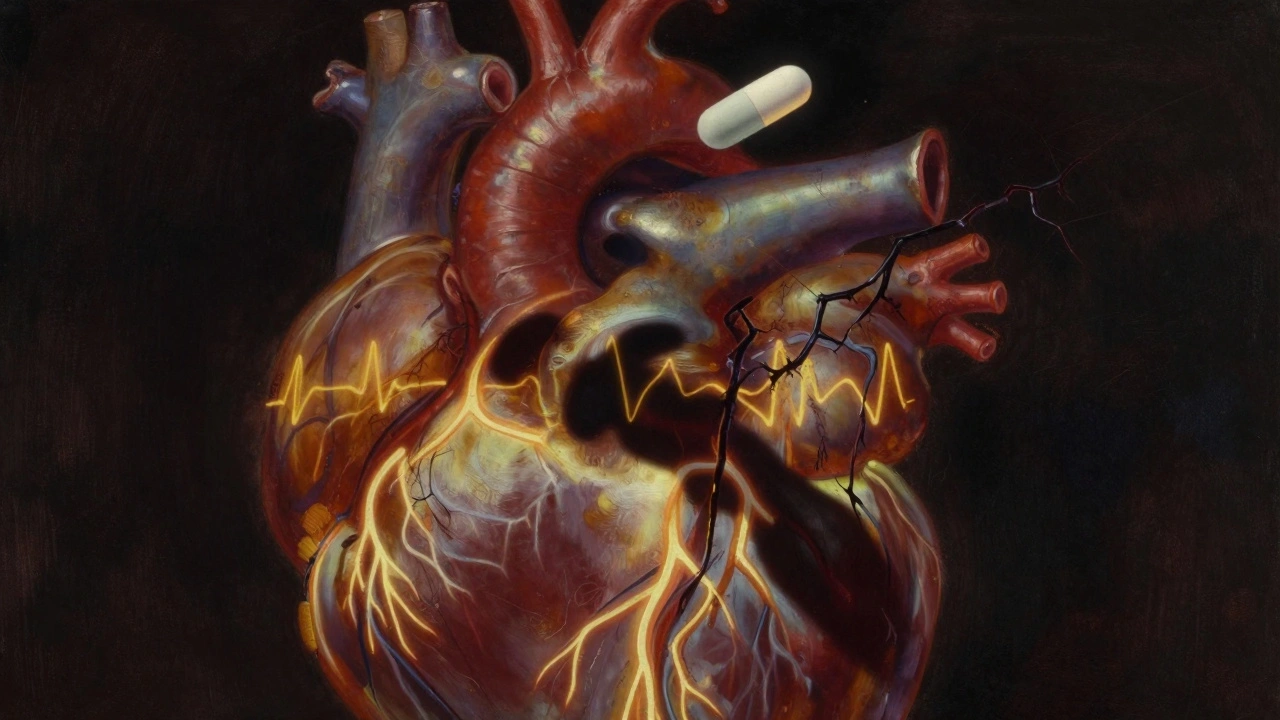
Methadone works by binding to opioid receptors, but it also has a hidden side effect: it blocks two key potassium channels in your heart-hERG and IK1. Most drugs that prolong the QT interval only touch one of these. Methadone hits both. That’s why it’s far more dangerous than other opioids like buprenorphine, which barely touches hERG at all.This dual blockade slows down the heart’s ability to reset after each beat. The result? A longer QT interval on your ECG. A normal QTc is 430 ms for men and 450 ms for women. Once it climbs past 500 ms, your risk of a life-threatening arrhythmia called torsades de pointes (TdP) jumps sharply. Studies show that nearly 7 in 10 men and 7 in 10 women on long-term methadone reach QTc levels above 450 ms. And about 1 in 10 reach the danger zone-over 500 ms.
It’s not just about the dose. Even at 60 mg/day, some people see QT prolongation. But above 100 mg/day, the risk becomes much more common. And here’s the kicker: the longer you’re on methadone, the worse it gets. Over 16 weeks, QTc can creep up by 10 milliseconds or more. That’s not a fluke-it’s a pattern.
The Perfect Storm: When Drugs Combine
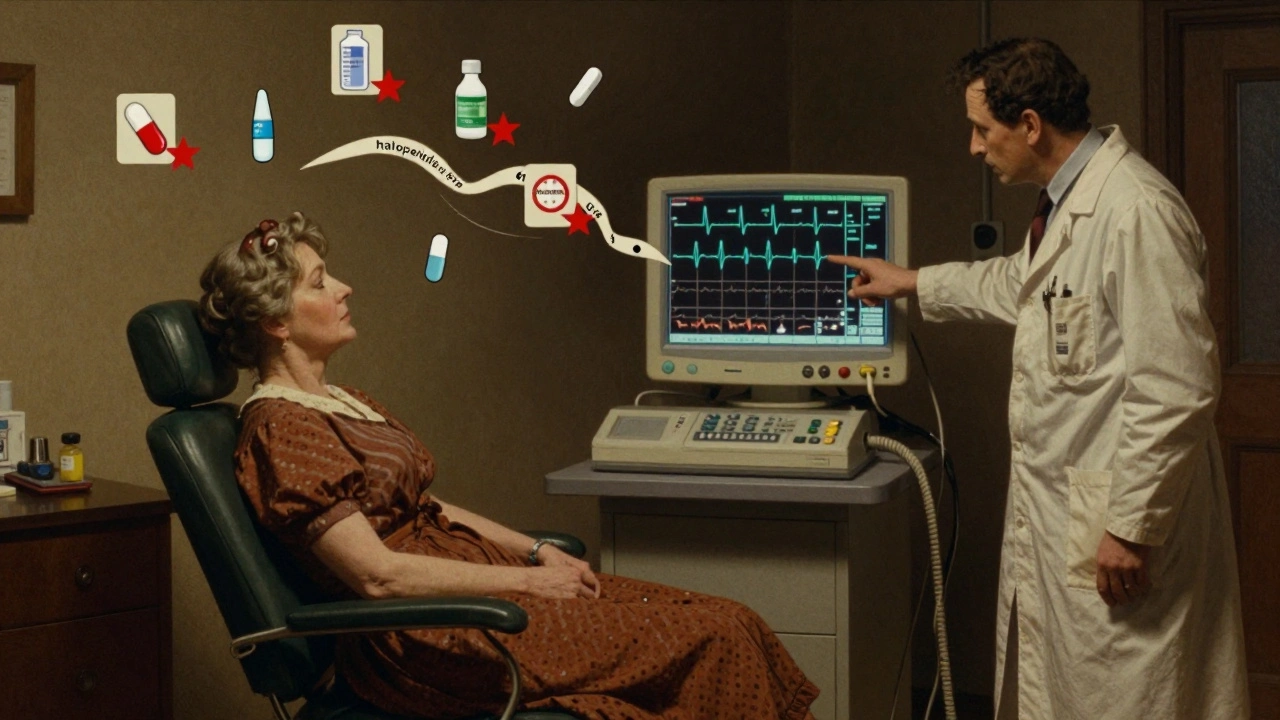
Methadone doesn’t act alone. Its danger spikes when paired with other drugs that also prolong the QT interval. Think of it like stacking weights on a tightrope. One weight? You might stay balanced. Two? You’re wobbling. Three? You’re falling.Common culprits include:
- Antibiotics: Erythromycin, clarithromycin, and moxifloxacin
- Antifungals: Fluconazole
- Psychiatric meds: Haloperidol, citalopram, venlafaxine
- HIV drugs: Ritonavir, which also slows methadone breakdown, making levels spike
One case from 2006 involved a patient on methadone who used cocaine. Cocaine isn’t even a long-term drug-it’s short-acting. But it still pushed the QT interval into dangerous territory. The combination didn’t need to be chronic to be deadly.
And it’s not just about the drugs themselves. Electrolytes matter. Low potassium or magnesium? That’s like removing the safety nets under the tightrope. Structural heart disease? That’s like walking on a broken rope. Add methadone into that mix, and you’re asking for trouble.
What the Data Shows
Research from 2007 found that methadone causes an average QTc increase of 10.8 milliseconds-more than most other opioids. But the real red flag? The variability. Some people’s QTc barely moves. Others spike past 500 ms. Why? Genetics, liver function, age, sex, and other meds all play a role. Women are more vulnerable than men, likely due to hormonal differences in heart repolarization.A 2022 study in the Journal of the American Heart Association revealed something new: methadone doesn’t just block IKr (the hERG channel). It also blocks IK1, a channel that helps stabilize the heart’s resting state. This explains why methadone causes more unstable rhythms than other QT-prolonging drugs. It’s not just slowing the heart-it’s making its electrical recovery chaotic.
Case reports from New Zealand and Sweden show real-world consequences. One patient on 120 mg/day of methadone had repeated episodes of TdP. When the dose was cut to 60 mg/day, the arrhythmia stopped. Another patient died suddenly at home after being on 150 mg/day. Neither had known heart disease. Both were on other QT-prolonging meds.
Who’s at Highest Risk?
Not everyone on methadone needs to panic. But certain people are walking into a minefield without knowing it:- Those taking multiple QT-prolonging drugs
- People with low potassium or magnesium
- Those with a history of long QT syndrome, heart failure, or bradycardia
- Women over 50
- Patients on doses above 100 mg/day
- Anyone with liver problems (methadone is metabolized there)
If you’re on methadone and have even one of these, your risk isn’t theoretical. It’s measurable. And it’s serious.
What Should You Do?
The good news? This risk is preventable. You don’t have to choose between pain relief, recovery, and your heart.Before starting methadone: Get a baseline ECG. It’s simple, cheap, and life-saving.
During treatment: Repeat the ECG after 2-4 weeks of dose changes, and again at 3 months. If you’re on high doses or multiple QT drugs, check every 3-6 months.
If your QTc is above 450 ms (men) or 470 ms (women): Talk to your doctor. Don’t wait for symptoms. Dizziness, fainting, or palpitations? That’s your body screaming. But QT prolongation often has no warning signs until it’s too late.
If your QTc hits 500 ms or more: This is a medical alert. Your doctor should consider:
- Reducing your methadone dose
- Switching to buprenorphine (which has 100 times less hERG blockade)
- Stopping or replacing other QT-prolonging drugs
- Correcting low potassium or magnesium
One study found that switching from methadone to buprenorphine not only lowered QTc but also improved treatment retention. That’s rare-usually, you sacrifice one benefit to gain another. Here, you gain safety without losing effectiveness.
The Bigger Picture
Methadone saves lives. It reduces overdose deaths by 20-50%, cuts crime, and helps people stay in treatment longer than alternatives. That’s why it’s still the gold standard for opioid dependence in many places.But safety isn’t optional. The FDA issued a black box warning in 2006 because people were dying-not from overdoses, but from heart rhythms gone wrong. Since then, guidelines have improved. But many providers still don’t check ECGs regularly. Patients don’t know to ask.
If you’re on methadone, ask your doctor: “Have you checked my QT interval? Are any of my other meds on the list of QT-prolonging drugs?” If they look confused, ask for a referral to a cardiologist or pharmacist who specializes in drug interactions.
The goal isn’t to scare you off methadone. It’s to make sure you’re not blindsided by a preventable heart rhythm problem. You’re doing the hard work of recovery. You deserve to do it without risking your heart.
What’s Next?
New research is looking at U-wave patterns and Tpeak-Tend intervals to predict risk better than just QTc alone. These tools might one day help identify who’s truly at high risk before anything goes wrong. But for now, the simplest tools work: an ECG, a medication review, and honest conversations with your care team.Methadone isn’t the enemy. But combining it with other QT-prolonging drugs without monitoring? That’s a gamble with your life. Don’t let it be yours.
Can methadone cause sudden death even if I feel fine?
Yes. Methadone can cause torsades de pointes without warning symptoms. Many people who die from this arrhythmia had no prior dizziness, palpitations, or fainting. That’s why regular ECG monitoring is critical-even if you feel perfectly healthy.
Is buprenorphine safer than methadone for my heart?
Yes. Buprenorphine has about 100 times less effect on the hERG potassium channel than methadone. Studies show it causes little to no QT prolongation. For people with heart risks or those on other QT-prolonging drugs, buprenorphine is often a safer alternative without sacrificing treatment effectiveness.
How often should I get an ECG on methadone?
Get a baseline ECG before starting. Then repeat it after 2-4 weeks of dose changes, and again at 3 months. If you’re on over 100 mg/day, have other risk factors, or take other QT-prolonging drugs, get checked every 3-6 months. Don’t wait for symptoms.
Can electrolyte imbalances make methadone more dangerous?
Absolutely. Low potassium (hypokalemia) or low magnesium (hypomagnesemia) makes your heart more vulnerable to arrhythmias. Even mild imbalances can turn a borderline QT prolongation into a life-threatening one. Blood tests for these electrolytes should be part of routine monitoring.
What should I do if I’m prescribed a new medication while on methadone?
Always tell your prescriber you’re on methadone. Ask: “Does this drug prolong the QT interval?” If they’re unsure, ask for a pharmacist to review your full medication list. Never start a new antibiotic, antifungal, or psychiatric drug without checking for interactions. Even short-term use can be risky.
ian septian
December 10, 2025 AT 08:31Just got my first methadone script last month. Got my ECG done right away-QTc was 442. Doc said I'm good but to watch it. Thanks for the heads-up.
William Umstattd
December 10, 2025 AT 12:04It's not rocket science. If you're taking more than one drug that affects your heart's electrical system, you're playing Russian roulette with your life. The FDA warned us in 2006. People still ignore it. This isn't just negligence-it's arrogance.
Sabrina Thurn
December 11, 2025 AT 08:37From a clinical pharmacology standpoint, methadone's dual blockade of hERG and IK1 is uniquely problematic. Unlike other QT-prolonging agents, it disrupts both repolarization and stabilization phases of the cardiac action potential. This explains the higher incidence of polymorphic VT, especially in patients with subclinical electrolyte shifts. Routine monitoring of serum K+ and Mg2+ is non-negotiable in this population.
Simran Chettiar
December 11, 2025 AT 18:37you know what is interesting is that in india we dont really test for qtc that often and yet methadone is used quite a bit in rehab centers and people just take it and dont think about the heart i mean isnt it strange how we focus on addiction but forget the body is still a body even if the mind is broken
Sarah Gray
December 12, 2025 AT 07:06If you're on methadone and didn't get a baseline ECG before starting, you're not a patient-you're a liability. Your doctor should be ashamed for letting you walk out the door without one. This isn't just medical advice. It's basic human decency.
Kathy Haverly
December 12, 2025 AT 14:17Oh great. Another article telling people they're gonna die. Newsflash: every drug has risks. Methadone keeps people alive. If you're too scared to take it, don't. But stop scaring everyone else into quitting because you think you know better than the science.
Suzanne Johnston
December 14, 2025 AT 00:03There's a balance here. Methadone saves lives, yes. But we can't ignore the cardiac risks. The real tragedy isn't the drug-it's the system that doesn't routinely screen. We're treating addiction like a moral issue instead of a medical one. That's what gets people killed.
Haley P Law
December 14, 2025 AT 14:09my heart is literally screaming at me rn 😭😭😭 i was on 120mg and clarithromycin for a sinus infection… ended up in the er with palpitations. they said QTc was 512. they switched me to buprenorphine and i feel like a new person. if you're on methadone and any antibiotic-STOP. and get checked.
Andrea DeWinter
December 16, 2025 AT 05:39my doc never told me to get an ECG until i asked. now i get one every 6 months. also got my magnesium checked-was low. took supplements and my QTc dropped 20ms. simple stuff but nobody talks about it
Steve Sullivan
December 16, 2025 AT 13:13bro this is wild. i was on methadone for 5 years, never had issues. then i started taking citalopram for anxiety. 3 months later i passed out in the shower. turned out QTc was 530. switched to buprenorphine and now i'm alive. if you're on any psych med with methadone-get an ecg. no excuses. 🙏
George Taylor
December 17, 2025 AT 04:28...and yet... you know... despite all this... people still... just... take it... without... thinking... about... the... consequences... it's... so... sad... really... it's... just... so... sad...
Carina M
December 17, 2025 AT 15:56It is imperative that all individuals prescribed methadone be subjected to a comprehensive cardiac evaluation prior to initiation of therapy, and that periodic electrocardiographic monitoring be mandated as a standard of care. Failure to do so constitutes a breach of the physician's fiduciary duty to the patient.
Ajit Kumar Singh
December 17, 2025 AT 22:00in india we dont even have proper cardiac care in most rehab centers and people just get methadone and go home if you die its your fault but if you live its god's will
Lisa Whitesel
December 17, 2025 AT 22:32So you're telling me people are dying because they didn't get an ECG? Wow. What a shock. People don't read labels. They don't ask questions. They just take pills. And now they're surprised when they die. What a surprise.
Larry Lieberman
December 19, 2025 AT 13:16Just got my QTc checked after reading this-468. Scared me. Switched from citalopram to sertraline. Doc said that helped. Also got my Mg levels checked. Low. Taking supplements now. 🤝❤️🩹