
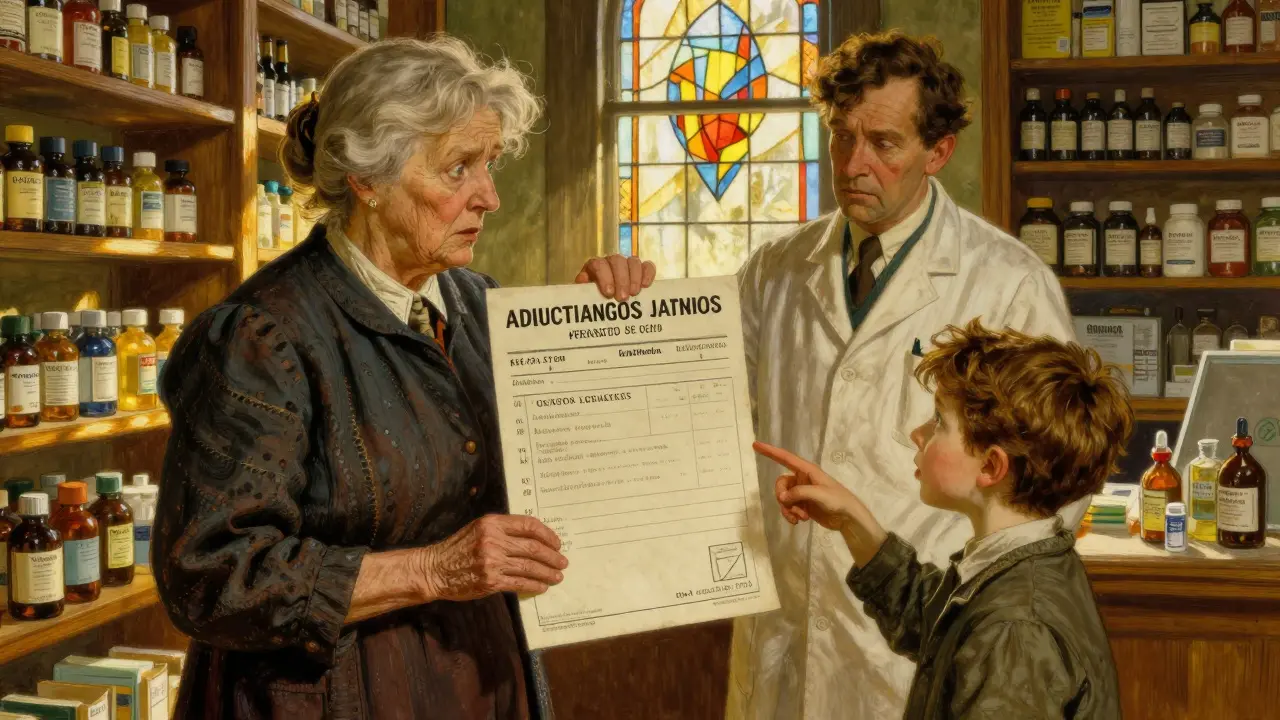
When you or a loved one is prescribed a new medication, the last thing you should worry about is whether you understand how to take it. But for millions of people with limited English proficiency, that’s exactly the reality. A 2022 study from the Children’s Hospital of Philadelphia found that children in families with limited English skills had medication errors at nearly twice the rate of English-speaking families-17.7% compared to 9.6%. These aren’t small mistakes. They’re hospital visits, overdoses, missed doses, and sometimes worse. The problem isn’t that people don’t care. It’s that the system isn’t built to help them.
Why Language Barriers Lead to Dangerous Mistakes
Medication instructions aren’t simple. They’re full of terms like "take with food," "do not crush," "swallow whole," or "use dropperful." Even native English speakers get confused. For someone who doesn’t speak English well, a pharmacy label printed only in English is like a puzzle with missing pieces. A 2020 review in PMC found that 34.7% of non-English-speaking patients couldn’t understand how to use their meds properly. And when family members try to help by interpreting, the risk goes up. Studies show that up to 25% of translations done by relatives or friends contain serious errors-misunderstanding "twice daily" as "once a day," or mixing up insulin doses because the term "units" wasn’t translated correctly.One Reddit user shared how their Spanish-speaking mother was given incorrect insulin instructions because the pharmacy used Google Translate. The result? She ended up in the ER. That’s not an outlier. It’s a pattern. The Agency for Healthcare Research and Quality (AHRQ) has been warning about this since 2005. And yet, a 2023 survey found that nearly half of pharmacies in high-Latino areas still can’t print prescription labels in Spanish. Even when they can, the translations are often incomplete or inaccurate. Terms like "for thirty days" or "take on an empty stomach" aren’t always translated at all.
What Works: Professional Interpreters and Direct Observation
The best solution isn’t fancy tech or apps. It’s trained, professional interpreters. Whether they’re in-person, on the phone, or via video, certified medical interpreters know the language of medicine. They don’t just translate words-they understand context. A 2017 study in the Journal of General Internal Medicine showed that using professional interpreters cut medication errors by up to 50%. That’s not a guess. That’s data from real hospitals.One of the most powerful tools is directly observed dosing. This means a nurse or pharmacist watches the patient take their first dose. They ask the patient to show them how they’ll take the pill, use the inhaler, or draw up the insulin. Even if there’s a language gap, seeing the action removes guesswork. In one hospital, this simple step reduced errors among LEP patients by 40% in just one year. It doesn’t take much time-just a few extra minutes per visit. But it saves lives.
Another proven method is the teach-back technique. Instead of asking, "Do you understand?"-which most people say yes to, even if they don’t-the provider asks, "Can you tell me in your own words how you’ll take this medicine?" If the patient stumbles, the provider explains again. This isn’t just polite. It’s a safety net.
What Doesn’t Work: Family Members, Google Translate, and Assumptions
Too often, hospitals and pharmacies rely on whoever is in the room. A child. A cousin. A neighbor. These people aren’t trained. They don’t know medical terms. They might skip parts they don’t understand. They might translate what they think the provider said, not what was actually said. A Milwaukee study found that 1 in 9 pharmacies still use family members as interpreters. That’s not convenience. That’s negligence.Google Translate and other apps are worse. They’re not designed for medical language. They don’t know the difference between "tablet" and "capsule." They don’t understand dosage units. They can’t adjust for cultural context. One pharmacy in New York used a translation app that turned "take with water" into "take with wine." That’s not a glitch. That’s a disaster waiting to happen.
And then there’s the assumption: "They’ll figure it out." Or, "They didn’t ask, so they must understand." That mindset kills. A 2023 KFF survey found that 30% of LEP adults couldn’t understand their provider’s instructions. And 27% had trouble filling prescriptions. If you’re not asking, you’re not helping.

What You Can Do: Steps to Get Help
If you or someone you care for has limited English proficiency, here’s what you can do right now:- Ask for an interpreter-at every appointment, pharmacy visit, and hospital check-in. You have the legal right to one. Under Title VI of the Civil Rights Act, any healthcare provider receiving federal funds must provide free language services.
- Request translated materials-ask for pill bottles, instructions, and brochures in your language. If they say they don’t have them, ask if they can print them from a trusted source. Many pharmacies now have digital systems that can generate labels in over 100 languages.
- Use the teach-back method-after your provider explains something, say, "Can I show you how I’ll take this?" Then do it. If you’re unsure, say so. It’s better to look slow than to be sick.
- Bring a trusted advocate-someone who speaks both languages well and can help you ask questions. Not just a translator, but someone who can speak up if something doesn’t sound right.
- Report problems-if you’re denied an interpreter, if labels are missing, or if you’re told "we don’t have that language," file a complaint. Contact the provider’s patient relations department or the Office for Civil Rights at HHS. They take these complaints seriously.
What Health Systems Need to Fix
This isn’t just a patient problem. It’s a system failure. Hospitals and pharmacies are required by law to provide language services. But many don’t. Why? Cost. Training. Lack of leadership. A 2023 University of Michigan study found that 29% of hospitals don’t even offer online language tools. Another survey said 68% of hospitals don’t identify LEP patients before they arrive. That’s like handing someone a map in a language they don’t read and expecting them to find their way.The fix is simple but requires commitment:
- Ask every patient their preferred language at registration-not just once, but every time.
- Contract with professional interpretation services, not just rely on staff who "speak a little Spanish."
- Train all staff on cultural humility and how to use interpretation tech.
- Print medication instructions in the top 10 languages spoken in your community.
- Use directly observed dosing for high-risk drugs like blood thinners, insulin, or seizure meds.
It’s not expensive. Professional interpreters cost $3.50 to $6 per minute. That’s less than a cup of coffee. And the cost of a medication error? Up to $1.7 billion a year in the U.S. alone. Investing in language access isn’t charity. It’s smart business-and it’s the law.
Looking Ahead: What’s Changing
There’s progress. In 2022, Medicare started reimbursing for telehealth interpretation. In 2023, the FDA announced it’s working on new rules for multilingual prescription labels. Epic and Cerner, the two biggest electronic health record systems, are rolling out new tools in 2024 that automatically flag language needs and connect patients to interpreters. The National Institutes of Health is even testing AI tools that can translate medication instructions in real time-though experts warn they’re not ready to replace humans yet.But the real change will come when we stop treating language access as an afterthought. It’s not a bonus. It’s part of safe care. Just like sterilizing instruments or checking allergies. If you don’t do it, people get hurt.
By 2030, one in four Americans will speak a language other than English at home. The need isn’t going away. It’s growing. The question isn’t whether we can afford to fix this. It’s whether we can afford not to.
Can I be denied an interpreter at the pharmacy or hospital?
No. Under Title VI of the Civil Rights Act, any healthcare provider that receives federal funding-this includes most hospitals, clinics, and pharmacies-is legally required to provide free interpreter services. You have the right to a professional interpreter in person, by phone, or via video. If you’re told no, ask to speak to a supervisor or file a complaint with the Office for Civil Rights at HHS.
Is it okay to use a family member to translate medication instructions?
It’s better than nothing, but it’s risky. Studies show that up to 25% of translations by family members contain serious errors-misunderstanding doses, skipping warnings, or confusing similar-sounding drug names. A child translating insulin instructions for their parent is not safe. Always ask for a professional interpreter, especially for high-risk medications like blood thinners, diabetes drugs, or seizure meds.
What if my pharmacy won’t print my prescription label in my language?
Ask them to use a digital translation system. Most major pharmacy chains now have software that can print labels in over 100 languages. If they say they can’t, ask them to call their corporate office or contact a different pharmacy. You can also request a printed handout in your language from your doctor’s office. Don’t leave without clear instructions.
Are there free interpreter services I can use at home?
Yes. Many hospitals and community health centers offer free phone or video interpreter services. Call your provider’s main line and ask for the language services department. You can also use the National Council on Interpreting in Health Care’s directory to find certified interpreters in your area. Some nonprofits and immigrant support groups offer free translation help for medical visits.
How do I know if a medication instruction is translated correctly?
Look for three things: Does it include the drug name, dose, frequency, and purpose? Is it printed on the label or as a separate handout? Is it from a trusted source like your doctor’s office or a major pharmacy chain? If it’s a printout from Google Translate or a handwritten note, don’t trust it. Ask for a professionally translated version. If you’re unsure, call your pharmacist and ask them to explain it in your language.
What to Do Next
If you’re a patient: Speak up. Ask for help. Don’t pretend to understand. Write down your questions before your appointment. Bring someone with you. If something doesn’t feel right, say so.If you’re a caregiver: Advocate. Help your loved one ask for an interpreter. Double-check labels. Watch them take their first dose. Don’t assume they know what to do.
If you’re a provider: Start today. Ask every patient their language. Train your staff. Use interpreters-not family. Use teach-back. Use direct observation. It’s not just ethical. It’s the law. And most of all-it saves lives.
Carolyn Rose Meszaros
January 19, 2026 AT 17:02OMG this is so real 😭 I had to translate my abuela’s insulin instructions last year and I literally cried because the label said 'take 2 units' but the pharmacist didn’t even check if I knew what a 'unit' was. We got lucky she didn’t overdose. Everyone needs to stop using family as interpreters-this isn’t just inconvenient, it’s life or death.
Greg Robertson
January 19, 2026 AT 17:36Really appreciate you laying this out so clearly. I work in a clinic and we’ve started using video interpreters for all high-risk meds-like insulin and blood thinners-and the drop in errors has been wild. It’s not hard, just needs prioritization. Also, teach-back is a game-changer. Simple, cheap, effective.
thomas wall
January 20, 2026 AT 07:01It is frankly unconscionable that, in the 21st century, healthcare institutions continue to rely on untrained individuals to translate life-critical medical instructions. The negligence is not merely systemic-it is morally indefensible. The Civil Rights Act is not a suggestion; it is the law. To permit a child to interpret insulin dosing is not cultural accommodation-it is malpractice by proxy. The cost of professional interpretation is negligible compared to the human and financial toll of preventable errors. This is not a ‘challenge’-it is a failure of basic human decency.
Paul Barnes
January 21, 2026 AT 22:52Minor correction: The study cited from the Children’s Hospital of Philadelphia was published in 2021, not 2022. Also, 'dropperful' is not a medical term-it's colloquial. The correct term is 'milliliter' or 'mL.' Precision matters, especially in medication safety. And yes, Google Translate turned 'take with water' into 'take with wine'-that’s not a glitch, that’s a lawsuit waiting to happen.
Art Gar
January 23, 2026 AT 08:50Let’s be honest: this isn’t about language. It’s about entitlement. People who move to the U.S. and refuse to learn English are placing an unreasonable burden on the system. Why should pharmacies spend thousands on multilingual labels when the solution is simple-learn the language? We’re not a translation service. We’re a country. If you want to live here, engage with it. This is cultural laziness dressed up as a civil right.
Edith Brederode
January 24, 2026 AT 12:50Thank you for this. 💙 My mom’s pharmacy finally started printing labels in Tagalog last month-and I cried. Not because it’s amazing, but because it took 7 years. Please, if you’re a provider: just ask. Don’t assume. Don’t wait for them to ask. They’re scared. We’re all just trying to survive.
Emily Leigh
January 24, 2026 AT 13:23Okay, but… what if the interpreter is bad? What if they’re just some guy from the lobby who ‘speaks Spanish’? I’ve seen it. They say ‘take twice a day’ but actually mean ‘take when you feel like it.’ And then the system blames the patient. Why is no one talking about how broken the interpreter training system is? It’s not just about hiring-they need to be vetted, tested, paid, and held accountable. Otherwise, it’s just theater.
Renee Stringer
January 25, 2026 AT 11:53I’m not against language services-but this post feels like a guilt trip. People should take responsibility for their own health. If you don’t understand English, learn it. Or hire a translator. Don’t expect hospitals to be your personal language school. This isn’t charity-it’s a mandate that’s becoming unsustainable.
Crystal August
January 27, 2026 AT 07:41This is all just performative activism. Nobody cares about language barriers until someone gets sued. The real issue? The government forces hospitals to provide interpreters but doesn’t fund it. So hospitals cut corners. And now we’re supposed to feel bad? Wake up. It’s not about empathy-it’s about budget lines. Stop pretending this is a moral issue. It’s a funding crisis wrapped in emotional language.
Thomas Varner
January 28, 2026 AT 02:33My cousin’s kid was born with a rare condition. Every time we went to the hospital, they had an interpreter. Not just once-every visit. They even printed the discharge instructions in Vietnamese. And guess what? No errors. No ER trips. Just… good care. It’s not magic. It’s basic. If you wouldn’t hand a diabetic a syringe without showing them how to use it, why would you hand them a pill bottle in a language they don’t read? It’s not complicated. It’s just… not done.
clifford hoang
January 29, 2026 AT 23:17They’re using AI to translate meds now? 😏 Yeah right. That’s just the next step in the Great Medical Control Agenda. You think Google Translate is bad? Wait until the AI starts ‘optimizing’ your prescriptions based on your ‘risk profile.’ Next thing you know, your insulin dose gets auto-adjusted because your ‘language proficiency score’ is too low. Wake up. This isn’t safety-it’s surveillance with a side of bureaucracy.
Shane McGriff
January 31, 2026 AT 00:09One of the most powerful things I’ve seen? A nurse asking a patient to show her how they’ll take the pill. No translation needed. Just observation. I’ve watched it work with people who spoke zero English-and it saved lives. You don’t need fluency to demonstrate. You just need someone willing to watch. That’s the real secret: presence over translation. And it’s free.
Jacob Cathro
January 31, 2026 AT 10:56bro the fact that pharmacies still use google translate is wild. i had a friend get a label that said 'take 2 tabs w/ juice' and it was supposed to be 'with water'-she drank orange juice and ended up in the ER bc it interacted with her blood pressure med. like… how is this still a thing? someone’s getting paid to do this. someone. someone is getting paid to translate 'water' as 'juice' and not get fired.