

What is hypoparathyroidism?
Hypoparathyroidism is a rare endocrine disorder where the parathyroid glands don’t make enough parathyroid hormone (PTH). Without enough PTH, your body can’t keep calcium levels stable. This leads to low blood calcium (hypocalcemia), high phosphate levels, and problems with bone and nerve function. Most cases happen after thyroid or neck surgery-about 8 out of 10 people with this condition developed it after an operation. But it can also come from autoimmune disease, genetic disorders like DiGeorge syndrome, or radiation damage to the glands.
Why does low calcium matter?
Calcium isn’t just for bones. It helps your nerves send signals, your muscles contract, and your heart beat regularly. When calcium drops too low, you start feeling it. Common symptoms include tingling in your fingers, lips, or toes; muscle cramps, especially in your hands and feet; fatigue; and sometimes seizures. Some people get brain fog, anxiety, or dry skin. These symptoms can come and go, which makes them easy to miss-or worse, blame on stress or lack of sleep. But if you’ve had neck surgery and keep feeling weird like this, low calcium could be the real cause.
How do doctors treat it?
There’s no cure yet, but you can manage it well with two main things: calcium and active vitamin D. You don’t get PTH replaced directly (like you would with thyroid hormone), so you’re replacing what it does instead. The standard treatment is calcium supplements and a special form of vitamin D called calcitriol or alfacalcidol. These bypass the need for PTH to activate vitamin D in your kidneys. Regular vitamin D3 (cholecalciferol) won’t work as well because your body can’t convert it without PTH.
What doses should you take?
There’s no one-size-fits-all dose, but most people start with 1,000 to 2,000 mg of calcium daily, split into two or three doses taken with meals. Why with food? Because calcium helps bind phosphate in your gut, and it’s absorbed better when eaten. Calcium carbonate is the most common form-it has 40% elemental calcium, so you need less of it than calcium citrate (which only has 21%). For example, you’d take about 1,250 mg of calcium carbonate to get 500 mg of actual calcium. Active vitamin D usually starts at 0.25 to 0.5 micrograms per day. Your doctor will adjust this based on your blood tests.
What about vitamin D3?
Even if you’re on active vitamin D, you still need regular vitamin D3-about 400 to 800 IU per day. This keeps your overall vitamin D stores up. The goal is to keep your 25-hydroxyvitamin D level between 20 and 30 ng/mL. Too low, and your body struggles to absorb calcium. Too high, and you risk kidney stones or other issues. It’s a tight balance.
Why magnesium matters more than you think
If your magnesium is low, your body can’t use calcium or vitamin D properly-even if you’re taking plenty. Magnesium helps PTH work and helps calcium move into cells. Many people with hypoparathyroidism have low magnesium without realizing it. The target is 1.7 to 2.2 mg/dL. If you’re below that, your doctor will likely prescribe magnesium oxide (400-800 mg daily) or magnesium citrate (200-400 mg daily). Fixing magnesium often improves muscle cramps and makes your other meds work better.
What foods should you eat-or avoid?
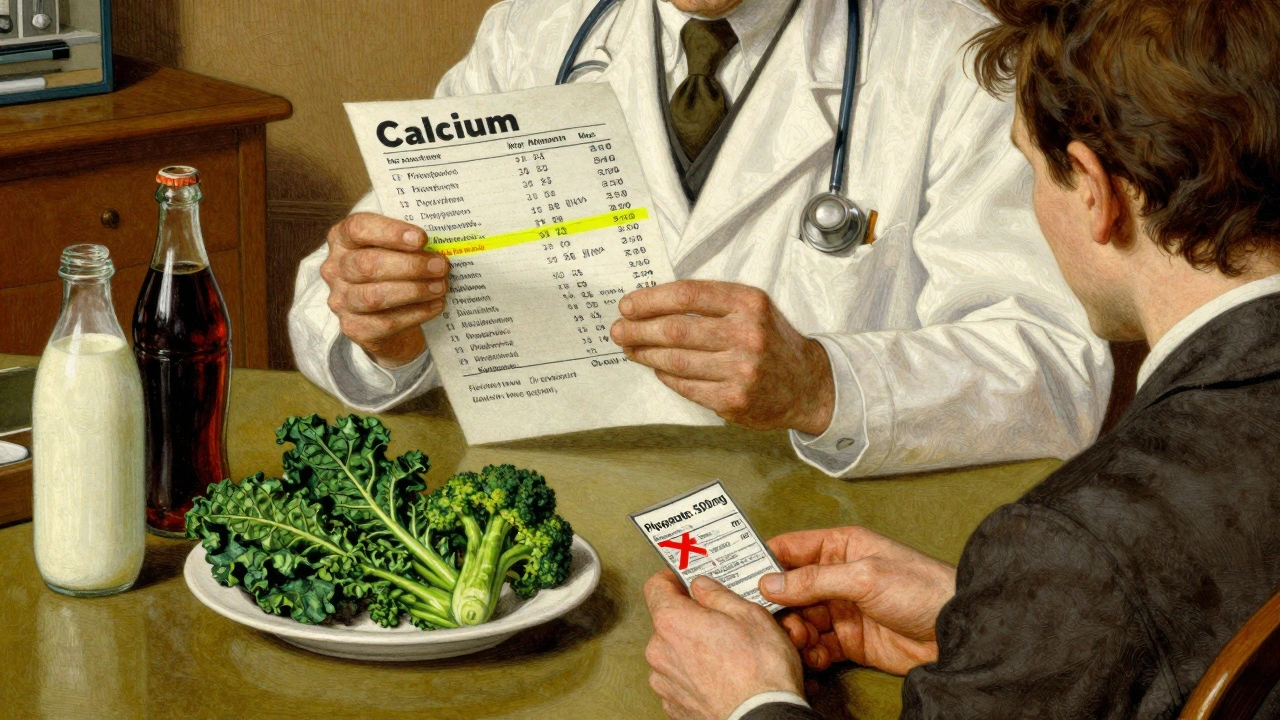
You need calcium-rich foods: dairy (one cup of milk has about 300 mg), kale (100 mg per cup), broccoli (43 mg per cup), and fortified plant milks. But you also need to limit phosphate. Too much phosphate makes calcium drop even lower. Avoid soda (one liter can have 500 mg of phosphoric acid), processed meats (150-300 mg per serving), and hard cheeses (500 mg per ounce). Aim for less than 1,000 mg of phosphate daily. It’s harder than it sounds, but reading labels helps.
How do you know if treatment is working?
You’re not just checking your calcium. Doctors look at four things: serum calcium, serum phosphate, 24-hour urine calcium, and magnesium. Your target serum calcium should be in the lower half of normal-about 2.00 to 2.25 mmol/L (8.0-8.5 mg/dL). Too high, and you risk kidney stones or calcium deposits in your brain. Too low, and you get symptoms. Urine calcium should be under 250 mg per day. If it’s higher, you’re at risk for kidney damage. Blood phosphate should stay between 2.5 and 4.5 mg/dL. You’ll get blood tests every 1 to 3 months at first, then every 3 to 6 months once you’re stable.
What if standard treatment isn’t working?
About 1 in 3 people still struggle even with high doses. If you need more than 2 grams of calcium or more than 2 micrograms of active vitamin D daily, or if your urine calcium stays too high despite diet and meds, it’s time to talk about alternatives. One option is a synthetic PTH injection-either Natpara (recombinant human PTH 1-84) or Forteo (teriparatide). These are expensive-up to $15,000 a month-and require daily shots. But they can cut your calcium and vitamin D needs by 30-40%. Natpara was pulled from the U.S. market in 2019 over manufacturing issues but came back in 2020 with strict safety rules. Insurance approval can take 30-45 days, and not all pharmacies carry it.

New treatments on the horizon
There’s promising research. TransCon PTH, a long-acting PTH prodrug, showed in a 2022 trial that 89% of patients could keep calcium normal with just one weekly injection-compared to only 3% on placebo. This could mean fewer shots, fewer pills, and better quality of life. It’s not approved yet, but phase 3 trials are complete, and approval could come by 2026. Gene therapy targeting the calcium-sensing receptor is also being studied in animals, but human trials are still years away.
What can go wrong long-term?
Even if your calcium levels look good, there are hidden risks. Over 15 years, 15-20% of people develop early kidney disease. About 1 in 5 develop calcium deposits in the brain (basal ganglia calcification), which can cause movement problems or seizures. And if your calcium is too high for too long, you increase your risk of heart disease-studies show a 20-30% higher risk with calcium intake over 2,000 mg daily. That’s why keeping calcium in the lower normal range is so important. It’s not just about feeling better today-it’s about protecting your kidneys, heart, and brain for decades.
Living with hypoparathyroidism: daily tips
Most people take 6 to 10 pills a day. That’s a lot. To make it easier: take calcium with every meal and snack, keep vitamin D at bedtime (better absorption), and always carry extra calcium tablets. If you feel tingling or cramping, chew 2-3 tablets right away-500-1,000 mg of elemental calcium can stop an attack fast. Many patients report better stability when they split their calcium into 4 or 5 smaller doses instead of 2 or 3 big ones. Keep a log of symptoms, doses, and meals-it helps your doctor spot patterns. And don’t ignore magnesium. It’s the silent player that makes everything else work.
Who should you see?
Start with an endocrinologist. They’ll handle your first 3-4 visits to get your doses right. Once you’re stable, your primary care doctor can manage routine checkups-but only if they know what to look for. A 2021 survey found that 78% of family doctors feel underprepared to handle hypoparathyroidism. If you’re having trouble, ask for a referral back to an endocrinologist. You don’t need to be a specialist to manage this, but you do need to be informed.
What about mental health and support?
Living with a chronic, invisible illness is exhausting. A 2021 survey of 412 patients found that 68% struggle to keep calcium levels steady, and 52% have symptoms every day. Many describe it as a "calcium rollercoaster"-one day fine, the next dizzy and numb. Online communities like Reddit’s r/Hypoparathyroidism (with over 1,200 members) offer real advice, not just textbook info. Talking to others who get it helps. Don’t suffer in silence. Your mental health matters as much as your calcium level.
ian septian
December 9, 2025 AT 08:02Life hack: split doses. Four small ones beat two big ones.
Chris Marel
December 10, 2025 AT 20:34Evelyn Pastrana
December 12, 2025 AT 09:58Turns out my brain was just low on minerals.
Also, soda is the devil. Who knew?
Nikhil Pattni
December 14, 2025 AT 01:53You need to know that calcitriol is the only active form, not D3 - that’s basic endocrinology.
And magnesium? Most people don’t even know it’s a cofactor for calcium ATPase.
Also, Natpara’s not even the best option - teriparatide has better bioavailability, but it’s off-label.
And if your urine calcium is over 200 mg/day, you’re already on the path to nephrocalcinosis - get a DEXA scan and check your FGF23 levels.
Also, avoid dairy if you’re lactose intolerant - it’s not about calcium content, it’s about gut absorption.
And don’t even get me started on how the FDA messed up the Natpara recall.
My cousin’s endocrinologist in Mumbai uses a custom compounding formula with magnesium glycinate and calcitriol at 0.75 mcg - works better than anything FDA-approved.
And if you’re taking vitamin D3, you’re wasting money.
It’s all about the 25-OH-D levels - target 24 ng/mL, not 30.
And stop eating broccoli - it’s got oxalates that bind calcium.
Use kale instead.
And don’t forget to test your ionized calcium, not total.
Most labs lie about that.
Arun Kumar Raut
December 14, 2025 AT 22:39It’s not just about pills - small changes, like skipping soda and eating more greens, made a huge difference.
You’re not alone. There’s a whole community out there.
precious amzy
December 16, 2025 AT 21:25Is not the parathyroid gland, in its silence, a metaphysical testament to the fragility of homeostasis?
And to reduce the human experience to serum calcium levels and pill counts - is this not the epistemological collapse of medicine into algorithm?
William Umstattd
December 18, 2025 AT 13:35And if your doctor says ‘it’s fine’ when your urine calcium is 300 mg, they’re killing you slowly.
Stop listening to people who don’t have this.
You need to be your own advocate - or die.
Andrea Beilstein
December 18, 2025 AT 20:12and every cramp is a stanza and every blood test a line break
and the silence of the parathyroid is the pause that holds the whole thing together
Lisa Whitesel
December 19, 2025 AT 03:21You’re not a vitamin ad.
You’re a walking electrolyte disaster waiting to happen.
And if you’re not tracking your urine calcium, you’re just gambling with your kidneys.
Larry Lieberman
December 20, 2025 AT 21:32Also I switched to almond milk and cut out soda 🙌
Life changed
Richard Eite
December 22, 2025 AT 10:27Try living in a country where you can’t even buy calcitriol without a prescription.
And don’t get me started on Natpara prices.
This is why the West is broken.
Katherine Chan
December 22, 2025 AT 10:49Then I started logging my meals and doses.
Found out I was taking calcium with coffee - big mistake.
Now I take it with lunch and dinner.
My energy is back.
You got this.
One pill at a time