

If you or someone you care for struggles to swallow pills, you’re not alone. About 1 in 7 older adults living at home have trouble swallowing medications-and that number jumps to nearly 7 in 10 for those in nursing homes. It’s not just about discomfort. Skipping doses because pills feel stuck can lead to worsening health, hospital visits, or even dangerous side effects. The good news? There are real, safe ways to make taking medicine easier without risking your health.
Why Swallowing Pills Gets Harder With Age
Swallowing isn’t just a reflex-it’s a complex process involving muscles in your mouth, throat, and esophagus. As we age, or if we have conditions like Parkinson’s, stroke, dementia, or esophageal narrowing, those muscles weaken or misfire. Medications become harder to manage not because they’re bigger, but because the body’s ability to move them safely down the throat slows down.Some people think crushing pills or opening capsules is harmless. But a 2023 review found that nearly half of all modified medications were changed in ways that could reduce their effectiveness-or even cause harm. For example, crushing a time-release tablet can release its full dose all at once, leading to overdose. Opening a capsule meant to protect the stomach lining can cause irritation or nausea. Even mixing crushed pills with applesauce can change how the drug is absorbed.
What You Should Do Before Crushing or Breaking Pills
Before you crush, chew, or mix any medicine, ask these three questions:- Is this medicine still needed? Sometimes, after a hospital stay or recovery, you’re still on drugs you no longer need. A doctor can review your list and cut the extras.
- Is there a better form? Liquid, chewable, or dissolvable tablets might be available. For example, many blood pressure pills now come as orodispersible tablets that melt on the tongue.
- Is it safe to alter? Not all pills can be crushed. Coated, extended-release, or enteric-coated pills are especially risky. Check the label or ask your pharmacist.
The Pharmaceutical Journal and the UK’s NICE guidelines agree: altering medication should be the last option, not the first. Always talk to your pharmacist before changing how you take a drug.
Alternative Forms That Actually Work
If swallowing pills is a daily battle, ask your doctor or pharmacist about these alternatives:- Liquid formulations - Often available for antibiotics, blood pressure meds, and pain relievers. Some taste bitter, but many pharmacies can flavor them.
- Orodispersible tablets - These dissolve in seconds on your tongue. No water needed. Common for antidepressants, antipsychotics, and anti-nausea drugs.
- Effervescent tablets - Dissolve in water to make a drink. Good for painkillers like paracetamol and some vitamins.
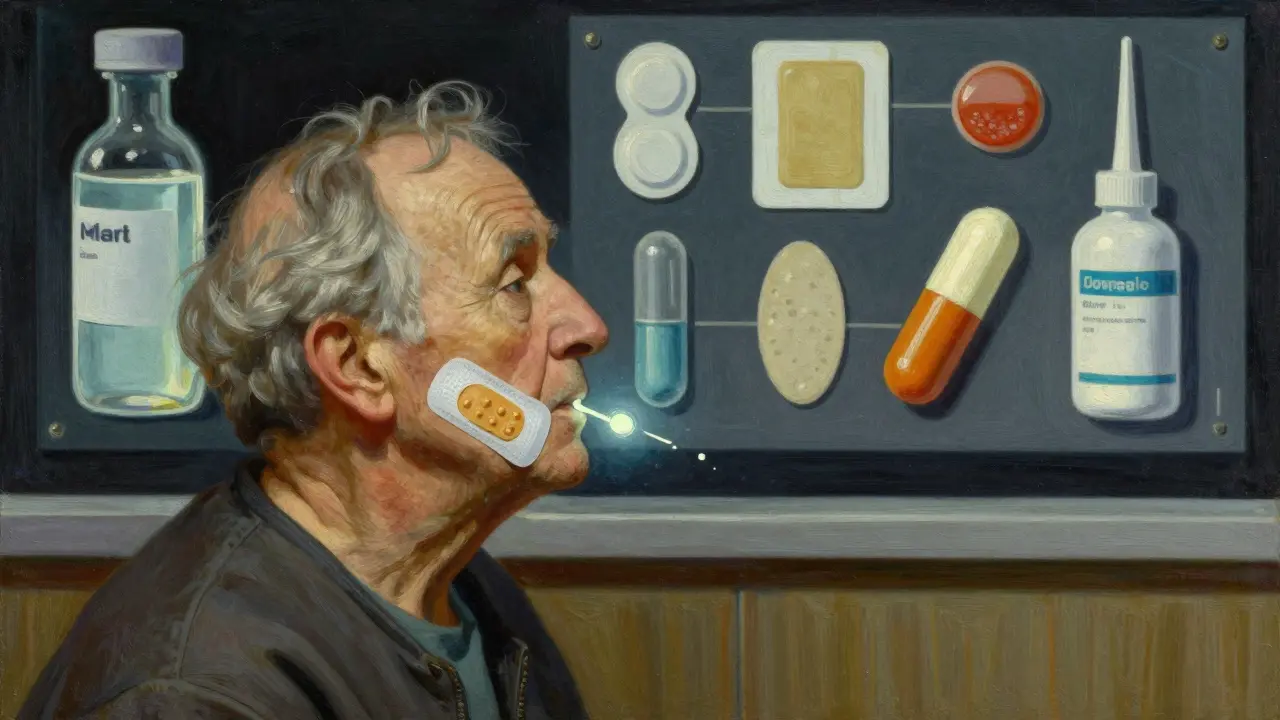
- Topical patches - For pain, hormone therapy, or nicotine replacement. No swallowing required.
- Rectal suppositories - Used for nausea, fever, or some seizure meds when oral intake isn’t possible.
- Dissolvable films - Newer tech like VersaFilm sticks to the inside of your cheek and releases medicine without swallowing. One 2023 study showed 85% of patients with moderate dysphagia could use them successfully.
But here’s the catch: only 37% of essential medicines have these alternatives, according to the FDA. That means you might need to push for them. If your drug isn’t available in a swallow-friendly form, ask your pharmacist if a similar drug is.
Safe Swallowing Techniques That Actually Help
If you must swallow a pill whole, try these proven methods:The Lean Forward Method - Works best for capsules. Place the capsule on your tongue. Take a medium sip of water. Tuck your chin to your chest (lean forward), then swallow. This moves the capsule away from the sensitive back of your throat. University of Michigan research found this technique improved success by up to 75%.
The Pop Bottle Method - Good for tablets. Place the pill on your tongue. Seal your lips around the opening of a plastic water bottle. Take a drink using suction. The suction pulls the pill down with the water. Many people find this easier than tipping their head back.
The Two-Sip Method - Use one sip to wet your mouth and throat, then a second sip to swallow the pill. Dry mouths make swallowing harder. Keep a glass of water nearby.
For kids - Have them take a sip of milk first to coat the throat. Or, place the pill on the tongue, fill the mouth with water, puff out the cheeks, swish, then swallow. The extra moisture helps.
What to Avoid When Managing Dysphagia
Don’t do these things, even if they seem harmless:- Don’t crush pills unless your pharmacist says it’s safe. Even then, only do it right before taking it.
- Don’t mix crushed meds with thick foods like peanut butter or yogurt unless advised. Thick foods can trap the medicine and delay absorption.
- Don’t use thin liquids if you’re at risk of aspirating (inhaling food/liquid into lungs). Use thickened drinks instead.
- Don’t assume a pill that worked before will always work. Your swallowing ability can change over time.
- Don’t ignore taste issues. Crushed pills often taste awful. Ask your pharmacist for flavoring options or try chilling the mixture.
How Care Teams Can Help
Managing swallowing problems isn’t just your job. It’s a team effort.Your doctor should ask: “Can you swallow your pills?” during every visit. If the answer is no, they should refer you to a speech-language pathologist. These specialists test swallowing function and recommend safe techniques or textures.
Your pharmacist can check if your meds have safer forms, flag dangerous interactions, and even contact your doctor to switch prescriptions. Many hospitals now have pharmacists who specialize in dysphagia.
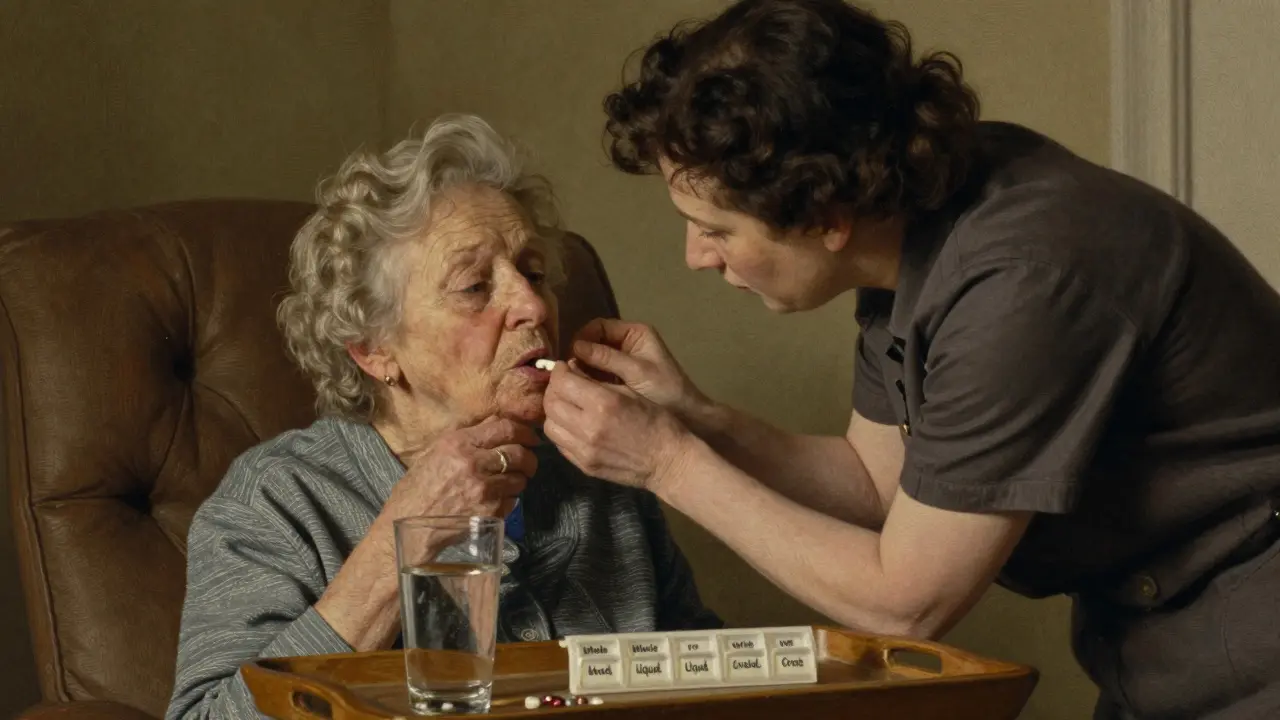
Nurses and caregivers need clear instructions. If someone is on 10 pills a day and they’re all crushed differently, errors happen. Use a pill organizer labeled with the form: “Whole,” “Liquid,” “Crushed with applesauce.”
The American Society of Health-System Pharmacists recommends that electronic health records flag patients with dysphagia so prescribers see it before writing a new prescription. That’s not universal yet-but you can ask for it.
When to Call for Help
See a doctor right away if you experience:- Pain when swallowing
- Food or pills getting stuck for more than a few seconds
- Coughing, choking, or wheezing after taking medicine
- Unexplained weight loss or frequent pneumonia
These could signal a deeper issue like esophageal narrowing or neurological decline. Treatments like dilation, stents, or Botox injections can help-but only if caught early.
What’s Changing in 2025
The global market for dysphagia solutions is growing fast-projected to hit $2.9 billion by 2029. Why? Aging populations. The WHO says 1 in 6 people will be over 65 by 2050.Drugmakers are responding. More companies are designing medications with swallowing in mind. The European Medicines Agency now requires labels to say if a pill can be crushed. The FDA is pushing for patient feedback in drug trials to include swallowing ability.
And new tech is coming. Dissolvable films, nasal sprays for pain meds, and even micropatches that release drugs through the skin are in development. These won’t replace all pills-but they’ll give people more choices.
Final Thought: Your Medicine Should Fit Your Life
Taking medicine shouldn’t feel like a battle. If swallowing is hard, don’t guess. Don’t assume it’s normal. Don’t risk your health by making unsafe changes.Start by talking to your pharmacist. Ask: “Is there a version of this that doesn’t require swallowing?” Then ask your doctor: “Is this drug still necessary?” And if you’re caring for someone else, watch for signs of struggle-not just the pill, but the hesitation, the cough, the water glass that never empties.
There are safer ways. You just need to ask for them.
Can I crush my pills and mix them with food?
Only if your pharmacist or doctor says it’s safe. Many pills-especially time-release, enteric-coated, or extended-release ones-can become dangerous when crushed. Crushing can cause overdose, reduce effectiveness, or irritate your stomach. Always check before doing it.
What if I can’t swallow any pills at all?
There are alternatives: liquids, dissolvable tablets, patches, suppositories, or even dissolvable films that stick to your cheek. Ask your pharmacist for options. If your current meds don’t have alternatives, your doctor might be able to switch you to a similar drug that does.
Why do some pills taste awful when crushed?
Many pills have coatings to mask bitter ingredients or control how they’re absorbed. When crushed, those coatings are broken, releasing the unpleasant taste. Pharmacies can sometimes add flavoring to liquids or crushed mixtures. Ask them.
Is it safe to use thickened liquids for swallowing pills?
It depends. If you’re at risk of aspirating (inhaling liquid into your lungs), thickened liquids are safer. But if you’re choking on thick food, thinner liquids work better. A speech therapist can assess your swallowing and recommend the right texture.
Can swallowing problems get worse over time?
Yes. Conditions like Parkinson’s, dementia, or stroke can slowly worsen swallowing ability. Even aging alone can reduce muscle strength. What worked last year may not work now. Regular check-ins with your doctor and speech therapist are key.
Should I tell my pharmacist I have trouble swallowing pills?
Absolutely. Pharmacists are trained to help with this. They can suggest safer formulations, warn you about dangerous modifications, and even contact your doctor to change prescriptions. Don’t assume they know-tell them clearly.
Jillian Angus
December 25, 2025 AT 01:16Just tried the pop bottle method last week for my dad's blood pressure pill and it actually worked. No more gagging. Weird but life-changing.
Now he drinks water like he's trying to win a contest.
Paula Villete
December 25, 2025 AT 02:12So let me get this straight-pharmacists are the unsung heroes of geriatric medicine now? I mean, we have AI that can diagnose cancer but we still need a human to tell us not to crush a pill? The system is broken but the people holding it together are quietly doing their jobs. Respect.
Also, dissolvable films? That’s like sci-fi but for grandma. I’m impressed.
And yes, I just called my pharmacist. She didn’t even blink. She said ‘I know.’
suhani mathur
December 25, 2025 AT 09:19Oh great. Another article that tells me to ‘ask my pharmacist’ like that’s a magic wand.
My pharmacist doesn’t even know what my meds are half the time. She just hands me the bottle and says ‘take one.’
Also, ‘ask your doctor’-sure, if your doctor has a 12-minute appointment and already forgot your name by minute 3.
But hey, at least the pill doesn’t taste like regret anymore. Maybe.
Still, I’m trying the lean forward thing tomorrow. Wish me luck.
Rachel Cericola
December 25, 2025 AT 16:10I’ve been a caregiver for my mom for five years now. She’s 82, has Parkinson’s, and takes 14 pills a day. We’ve tried everything. Crushing? Dangerous. Mixing with applesauce? She gags. Liquid? Too many flavors she hates. Then we found orodispersible tablets for her antidepressant. She didn’t even know she was taking medicine anymore. It just… dissolved. No water. No struggle. Just a tiny tablet on her tongue and she swallowed it like a candy.
That’s the moment I realized: it’s not about willpower. It’s about access. And access is a privilege. Only 37% of meds have alternatives? That’s not a gap-that’s a failure of pharmaceutical design. We’re treating elders like they’re broken machines that need to adapt to pills, not the other way around.
And yes, I’ve emailed my senator. I’ve called three drug companies. I’ve asked every pharmacist I’ve ever met. Someone needs to push this. It’s not just ‘convenience.’ It’s dignity.
Also, if you’re reading this and you’re a pharmacist: thank you. You’re the real MVP.
And if you’re a doctor: ask the question. Just ask. Don’t assume they’re fine. Look at their hands. Watch their throat. Listen to the sigh when they pick up the pill bottle.
Christine Détraz
December 26, 2025 AT 03:33I used to crush my dad’s meds because it was easier. Then he got sick. Turned out the time-release was all dumped into his stomach at once. He spent a week in the ER.
Now I keep a little notebook. Pill name. Form. Instructions. Whether it can be crushed. Who told me.
And I always double-check with the pharmacist. Even if they roll their eyes. Even if I’m in a rush.
Because one mistake, and you’re not just saving a pill-you’re saving a life.
EMMANUEL EMEKAOGBOR
December 26, 2025 AT 12:01This is a very well-structured and informative piece. The emphasis on professional consultation before altering medication is not only prudent but ethically imperative. The integration of clinical guidelines from NICE and the Pharmaceutical Journal lends substantial authority to the recommendations. Furthermore, the enumeration of alternative formulations demonstrates a commendable commitment to patient-centered care. One might argue that the pharmaceutical industry bears a moral obligation to prioritize accessibility in drug design, particularly for aging populations. The societal implications of dysphagia are profound and warrant policy-level intervention. I commend the author for highlighting the role of speech-language pathologists and pharmacists as essential stakeholders in this domain.
Lu Jelonek
December 27, 2025 AT 14:40My mom uses the two-sip method and swears by it. She says the first sip ‘wakes up’ her throat. I thought it was superstition until I saw her do it.
Also, we started using a pill organizer labeled ‘whole’ or ‘crushed with applesauce’-it’s a game-changer for caregivers. No more guessing.
And yes, I told my pharmacist. She gave me a free sample of the dissolvable version of his cholesterol pill. I cried.
It’s not about being ‘difficult.’ It’s about being human.
siddharth tiwari
December 27, 2025 AT 16:40They don’t want you to know this but the FDA is pushing dissolvable pills because they’re controlled by Big Pharma. Why? Because you can’t patent a pill you crush. But a film? That’s a subscription. That’s recurring revenue.
And why do you think they don’t make more liquid forms? Too hard to profit from.
Also, ‘ask your pharmacist’-yeah right. They’re just middlemen. The real power is in the patent office.
And if you think crushing pills is dangerous, wait till you find out what’s in the coating. I’ve seen the documents.
They’re not helping you. They’re selling you a solution you didn’t ask for.
Harsh Khandelwal
December 28, 2025 AT 15:04Man, I crushed my grandpa’s blood pressure pill with a spoon and mixed it in his pudding. He didn’t even notice. Now he eats pudding every day like it’s dessert.
But then he got dizzy. Then he fell. Then the hospital called.
Turns out the pill was time-release. Whole thing dumped in his gut like a bomb.
So now I just hide the pills in his coffee. Works better than the pudding. Tastes like dirt but he doesn’t care.
Also, I think the government is hiding the real solution. They want us to suffer so we buy more pills.
Just saying.
John Pearce CP
December 29, 2025 AT 18:35As a veteran, I’ve seen the decline of American healthcare. This article is a textbook example of why we’re losing the war on chronic illness. We’re not teaching people to adapt. We’re letting them beg for liquid forms and films because the system is broken. We need mandatory training for pharmacists. We need federal standards. We need accountability. Not just ‘ask your pharmacist.’ We need infrastructure.
And if you’re not advocating for change, you’re part of the problem.
Diana Alime
December 31, 2025 AT 06:54Ok but like… why is this even a thing? Why can’t pills just be gummies? Or popsicles? Or like… a spray? Why do we still live in the stone age of medicine?
I’m 30 and I can’t swallow pills. I’ve tried everything. The pop bottle? I choked. The lean forward? I gagged. I just… stare at the pill like it’s my enemy.
And now you’re telling me there’s a film that sticks to my cheek? Like a sticker? That’s the future? I’m both terrified and obsessed.
Also, my dog eats my pills when I leave them on the counter. So I guess I’m not the only one struggling.
Bhargav Patel
December 31, 2025 AT 12:10The physiological complexity of deglutition is often underestimated in public discourse. The neuromuscular coordination required for safe swallowing involves cranial nerves V, VII, IX, X, and XII, and any disruption-whether due to neurodegeneration, structural stenosis, or pharmacological interference-can precipitate aspiration pneumonia, the leading cause of mortality among elderly patients with dysphagia.
It is therefore not merely a matter of convenience but of survival. The recommendation to consult pharmacists is not an afterthought-it is a clinical imperative. The absence of standardized labeling regarding pill modification across jurisdictions remains a critical regulatory gap. One must also acknowledge the socioeconomic disparities in access to alternative formulations, particularly in low-resource settings.
Technological innovations such as dissolvable films represent a paradigm shift, yet their cost and availability remain prohibitive for many. Policy must evolve to match innovation.
Bartholomew Henry Allen
January 2, 2026 AT 07:47Why are we letting pharmaceutical companies dictate how we take medicine? This isn’t freedom. This is control. We need to demand pills that work for us, not the other way around. The American way is to adapt, not to beg for a version that doesn’t choke you.
And if you’re too lazy to swallow a pill, maybe you shouldn’t be taking it.
Just sayin’.
John Pearce CP
January 2, 2026 AT 09:16Actually, I spoke to my pharmacist yesterday. She said they’re working with a startup that’s making dissolvable patches for blood pressure meds. No swallowing. Just stick it on your arm. Like a nicotine patch.
It’s in trials. Should be out in 18 months.
So yeah. The future’s coming. But you have to be the one who asks for it.
Don’t wait for them to come to you.
Rachel Cericola
January 3, 2026 AT 07:52That’s the first piece of real hope I’ve heard in months.
I’ve been begging my mom’s doctor for years to switch her to something patch-based. He just says ‘we don’t have it.’
Now I have something to bring back. Thank you.
And if anyone reading this has access to a clinical trial for dissolvable patches-please, reach out. We need this. Not next year. Now.