
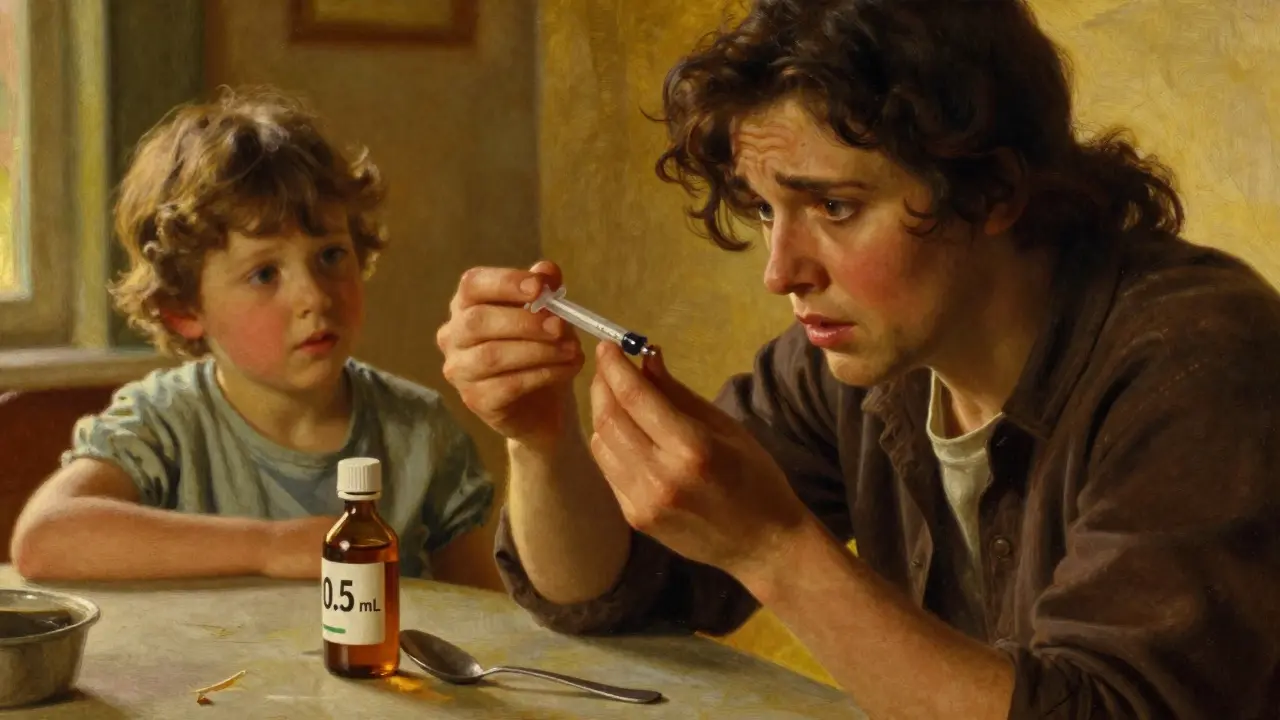
Getting the right amount of liquid medicine isn’t just about following the label-it’s about avoiding real, dangerous mistakes. Every year, thousands of people-especially children-get too much or too little medicine because the wrong tool was used to measure it. A cup that looks right might be off by half a teaspoon. A spoon from the kitchen? It could be double the dose. These aren’t hypothetical risks. Studies show liquid medication dosing errors happen in 15% to 43% of cases, and many of them come down to the device you’re using.
Why Household Spoons and Cups Are Dangerous
You’ve probably used a kitchen spoon to give a child medicine. It’s easy. It’s familiar. But it’s also risky. A teaspoon isn’t 5 mL. Not really. Not consistently. A coffee spoon might hold 3 mL. A soup spoon could be 10 mL. The same goes for cups. Even if a dosing cup says "5 mL," the way you hold it, the angle you look at it from, or how the liquid curves at the edges (called the meniscus) can throw off your reading by a full milliliter or more.The FDA and the American Academy of Pediatrics have been clear: stop using teaspoons and tablespoons for medicine. These units are outdated, inconsistent, and lead to errors. In one study, parents who used labels with milliliters (mL) made 42% fewer mistakes than those using teaspoons. That’s not a small difference. That’s the difference between a safe dose and a hospital visit.
And it’s not just parents. Nurses, caregivers, and even some pharmacists still hand out cups with confusing markings. One study found that 81% of dosing cups had too many lines-extra numbers that make it harder to find the right one. When you’re tired, stressed, or in a hurry, those extra lines become traps.
Oral Syringes Are the Gold Standard
The most accurate tool for measuring liquid medicine is the oral syringe. Not the kind you see in a hospital for injections-this one is designed for the mouth. It has clear, precise markings, usually in 0.1 mL increments. For a dose of 1.6 mL, you can measure it exactly. With a cup? You’d have to guess between 1 mL and 2 mL.Studies show oral syringes reduce dosing errors to under 4% for small doses like 2.5 mL. Compare that to cups, where error rates jump to 43%. Even when people think they’re using a cup correctly, parallax error-looking at the line from above instead of eye level-can cause a 10% or greater deviation. Syringes eliminate that. You’re reading the plunger, not a curved liquid surface.
People often resist syringes because they seem complicated. But once you’ve used one, you realize it’s simpler. You draw the liquid up, tap out the bubbles, and push the plunger slowly. No spills. No guessing. No confusion. In fact, 76% of Amazon reviews for oral syringes mention "precise measurements" and "no spills" as top benefits.
What to Look for in a Dosing Device
Not all syringes or cups are created equal. Here’s what you need to check:- Units must be in mL only. No teaspoons, tablespoons, or fl oz. The label and the device must match exactly.
- Markings should be clear and minimal. If the device has more than 3-5 markings, it’s probably over-marked. For a 5 mL dose, you should only see 1 mL, 2 mL, 3 mL, 4 mL, and 5 mL. Extra lines increase error rates.
- Leading zeros are required. Write "0.5 mL," not ".5 mL." This prevents misreading.
- No trailing zeros. Write "5 mL," not "5.0 mL." The extra zero implies precision that doesn’t exist.
- Device capacity should match the dose. A 30 mL cup for a 5 mL dose is a recipe for error. The device should never hold more than 2-3 times the largest dose.
Oral syringes should be provided for all doses under 10 mL. That’s the standard recommended by the American Pharmacists Association. For larger doses-say, 15 mL or more-a well-designed cup with clear, minimal markings can work, but only if it’s used correctly.
How to Teach Proper Technique
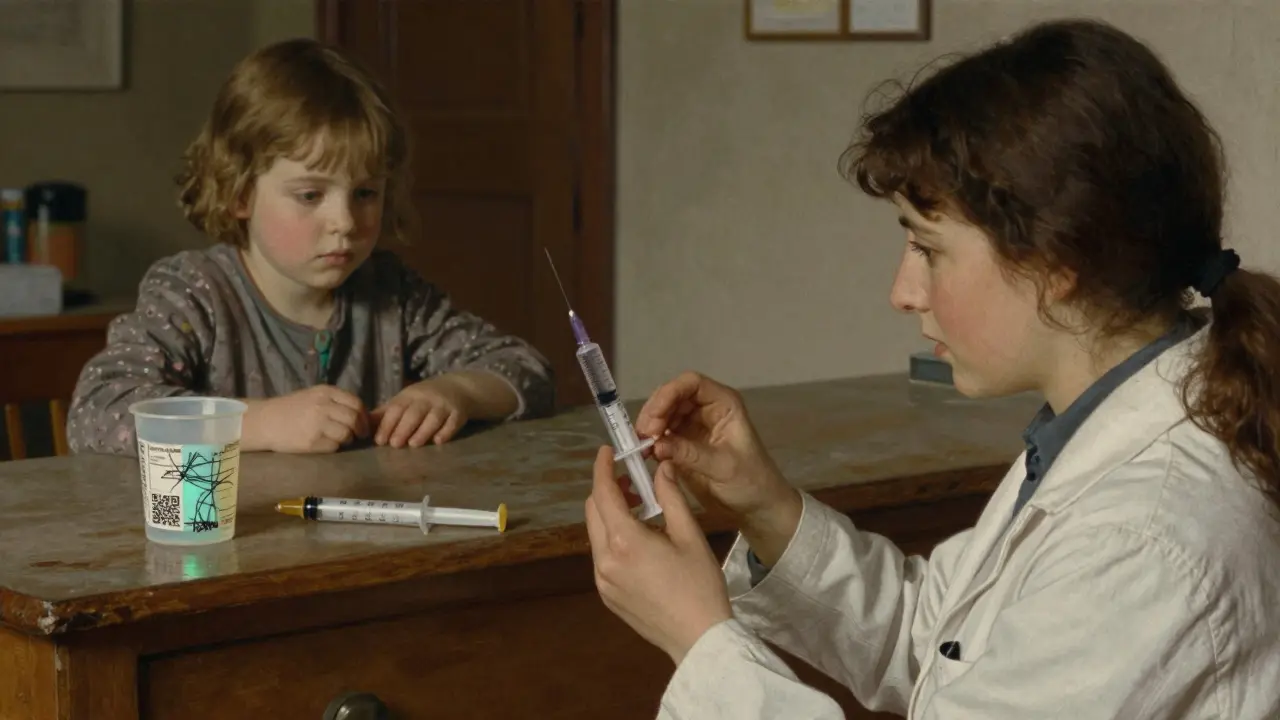
Giving someone a syringe isn’t enough. They need to know how to use it. The "teach-back" method works: ask the caregiver to show you how they’ll give the medicine. Watch them. Correct them. Then let them do it again.Here’s the step-by-step:
- Draw air into the syringe equal to the dose (e.g., 2 mL).
- Insert the tip below the liquid surface.
- Slowly pull back the plunger until the top of the plunger reaches the 2 mL mark.
- Tap the side of the syringe gently to bring any bubbles to the top, then push them out.
- Hold the syringe at eye level and check the plunger again.
- Give the dose slowly into the side of the mouth.
Practice with water first. Use a scale to verify accuracy. If the dose is 1.6 mL, and the scale shows 1.7 mL, you’re close enough. If it’s 2.2 mL, you’ve got a problem.
Studies show this method reduces dosing errors by 35%. It’s simple, low-cost, and effective.
What Pharmacies and Providers Should Do
Pharmacists are on the front lines. They’re the ones handing out the devices. Yet only 35% of pediatric liquid prescriptions in the U.S. come with an oral syringe. The rest get cups-even when the dose is under 5 mL.That needs to change. Pharmacies should:
- Provide an oral syringe for every liquid prescription under 10 mL.
- Remove any dosing cups that have extra markings or household units.
- Include a QR code on the label that links to a 60-second video showing how to use the syringe.
CVS and Walgreens have already started doing this. Their "DoseRight" and "PrecisionDose" programs use QR codes and Bluetooth-enabled syringes that connect to apps to confirm the dose. These aren’t gimmicks-they’re safety tools.
Hospitals and clinics should follow the NCPDP’s standardized labeling template. It’s free, it’s proven, and it’s been shown to boost compliance to 92%. Too many labels still say "give 1 tsp"-that’s not just outdated, it’s dangerous.

Why This Matters Beyond the Lab
This isn’t just about numbers on a page. It’s about real kids. Real families. One Reddit user, a pediatric nurse with 12 years of experience, wrote: "I’ve seen more medication errors from cups than any other device." Another parent said their infant almost overdosed because the cup only had 1 mL and 2 mL markings-but the dose was 1.6 mL.Low-income families are hit hardest. Studies show they receive lower-quality dosing devices 63% of the time. That’s not just unfair-it’s life-threatening.
Between 2015 and 2022, pediatric liquid medication errors dropped 37% in the U.S. That’s progress. But 7.8 errors per 100,000 emergency visits is still too high. The tools are here. The science is clear. The standards exist. What’s missing is consistent action.
What You Can Do Today
If you’re giving liquid medicine:- Ask for an oral syringe. Don’t accept a cup unless the dose is over 10 mL and the cup has only clear mL markings.
- Check the label and the device. Do they both say "mL"? Do they match?
- Use the teach-back method with whoever gives the medicine-your partner, your grandparent, your babysitter.
- Throw away any kitchen spoon you’ve used for medicine. Seriously. Just toss it.
If you’re a pharmacist, nurse, or doctor:
- Stop handing out cups for doses under 10 mL.
- Use standardized labels with mL only.
- Teach the technique. Don’t assume they know how to use it.
Accurate dosing isn’t about fancy technology. It’s about using the right tool, the right way, every time. Oral syringes aren’t perfect-but they’re the best we’ve got. And with clear labels, proper training, and consistent standards, we can stop these errors before they happen.
Can I use a kitchen teaspoon to give liquid medicine?
No. A kitchen teaspoon is not a calibrated measuring tool. It can hold anywhere from 3 to 7 milliliters depending on the spoon and how it’s filled. This inconsistency leads to dangerous under- or overdosing. Always use a device marked in milliliters (mL).
Why do dosing cups cause so many errors?
Dosing cups cause errors because of parallax (viewing the liquid from an angle), difficulty reading the meniscus (the curve of the liquid surface), and too many markings that confuse users. Studies show 43% of users make mistakes when using 15-mL cups for small doses. Syringes eliminate these issues entirely.
Is an oral syringe really better than a dosing cup?
Yes, for doses under 10 mL. Oral syringes have a mean error of only 0.5 mL for a 5 mL dose, while cups average 1.3 mL of error. In one study, 67% of users measured 5 mL correctly with a syringe, but only 15% did so with a cup. Syringes are more accurate, less prone to spills, and easier to use for precise doses.
What should the label say on a liquid medication bottle?
The label must use milliliters (mL) only, with no teaspoons, tablespoons, or fl oz. It should include leading zeros (e.g., 0.5 mL), not trailing zeros (e.g., 5 mL, not 5.0 mL), and clearly state the dose and frequency. The FDA and American Academy of Pediatrics require this standard to prevent confusion.
What if the pharmacy doesn’t give me a syringe?
Ask for one. Most pharmacies carry oral syringes, and many will provide one free of charge. If they refuse, request a prescription for a dosing syringe as a medical supply. You can also buy accurate oral syringes at any pharmacy or online-look for ones with 0.1 mL increments and mL-only markings.
Vanessa Barber
January 23, 2026 AT 04:51Look, I get the syringe thing, but my grandma gave me medicine with a spoon for 70 years and I’m still here. Maybe we’re overcomplicating this?
Laura Rice
January 23, 2026 AT 07:45OMG YES. I used a soup spoon once and my kid threw up for 3 hours. I felt like a monster. Now I only use the syringe they gave me at the pharmacy-and I keep it taped to the fridge. No more guessing. No more guilt. #DoseRight
Janet King
January 25, 2026 AT 06:26It is imperative that caregivers utilize only calibrated measuring devices marked in milliliters. The use of non-standardized household utensils presents a significant risk of dosage deviation. The American Academy of Pediatrics has issued clear guidelines on this matter. Compliance is non-negotiable.
Susannah Green
January 27, 2026 AT 00:47Just a quick note: if you're using a syringe, always tap out the bubbles-seriously, it's the #1 thing people forget. And don't just eyeball it-hold it at eye level. I used to think I was doing it right until I saw my own mistake on video. Now I do it with my kids every time. It's a habit, not a chore.
Kerry Moore
January 27, 2026 AT 06:39This is one of the most well-researched and actionable pieces I've read on pediatric medication safety. The statistical references are compelling, and the practical recommendations-especially the teach-back method-are grounded in real clinical experience. Thank you for elevating this issue.
Anna Pryde-Smith
January 27, 2026 AT 21:35Pharmacies are literally killing kids by handing out cups. This isn't 'inconvenient'-it's negligence. If you're still giving out teaspoons, you should be fired. And if you're a parent and you're still using a kitchen spoon, you're playing Russian roulette with your child's life. Wake up.
Oladeji Omobolaji
January 28, 2026 AT 19:46Back home in Nigeria, we use spoons because syringes are expensive and hard to find. But I get it-this is smart. Maybe someone should make cheap, reusable syringes for low-income areas? Just a thought.
dana torgersen
January 30, 2026 AT 14:00...and yet, we live in a world where a .5ml difference can mean life or death, but we still can't agree on whether to write 'mL' with a capital L or not... isn't that just... ironic? We're obsessed with precision in the numbers, but not in the language that describes them... which is kind of like trying to build a house with a ruler that's 2mm off...
Sallie Jane Barnes
January 31, 2026 AT 11:29You are doing important work. Every parent, nurse, and pharmacist needs to read this. I'm sharing it with my entire family group chat. We’re all switching to syringes tomorrow. No more excuses. You’ve made this feel urgent-and that’s what changes behavior.
Andrew Smirnykh
February 1, 2026 AT 01:31I appreciate how this bridges cultural and economic gaps. The fact that low-income families are disproportionately affected by poor dosing tools is a systemic issue. It’s not just about education-it’s about access. I hope this sparks policy change beyond individual responsibility.
charley lopez
February 3, 2026 AT 01:12The operational variables associated with meniscus interpretation and parallax-induced measurement variance in graduated volumetric devices are statistically significant (p<0.01) when compared to piston-driven calibration systems. The oral syringe demonstrates superior metrological fidelity, particularly in sub-10mL dosing scenarios.
Kerry Evans
February 4, 2026 AT 18:58Of course you’re telling people to use syringes. You didn’t mention that 80% of those syringes are made in China and leak after two uses. And you didn’t say anything about the fact that most people can’t afford them. So you’re just preaching to the privileged. Meanwhile, real families are still using spoons because they can’t afford your ‘gold standard.’