
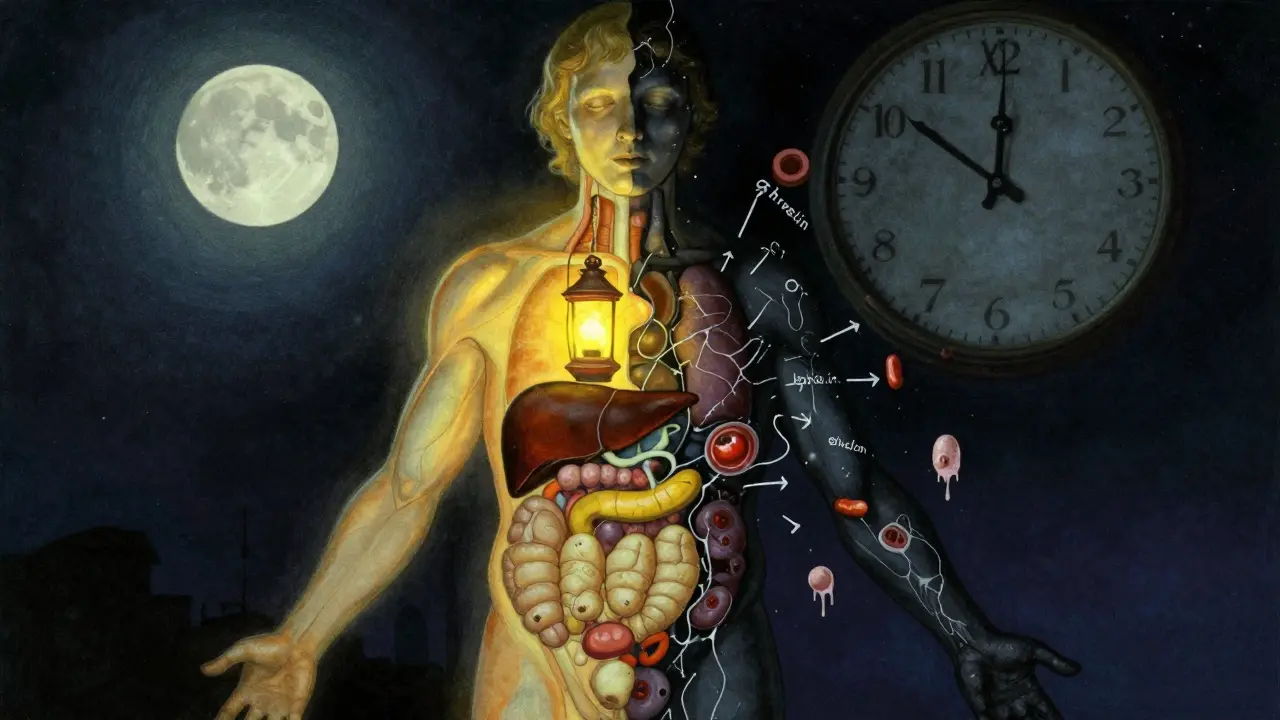
Ever wonder why you can eat the same amount of food and still gain weight - especially if you work nights or toss and turn most nights? It’s not just about calories in and calories out. Your body’s internal clock, called the circadian rhythm, plays a huge role in how you burn energy, store fat, and even crave food. When this clock gets out of sync - whether from late nights, shift work, or scrolling before bed - your metabolism starts to misfire. And that’s where the pounds creep on.
What Your Body Does When You Sleep (And What Happens When You Don’t)
Your circadian rhythm isn’t just about feeling tired or awake. It’s a 24-hour cycle that controls everything from your body temperature to hormone release, digestion, and how your cells use energy. The master clock sits in your brain, but every organ - your liver, fat cells, pancreas - has its own tiny clock that syncs up with it. When you sleep at night and eat during the day, everything works smoothly. But when you flip that pattern, your body gets confused. A 2014 study in PNAS put 14 healthy people through simulated dayshift and nightshift schedules. Even when they ate the same meals, those on night shifts burned about 55 fewer calories per day. That’s like walking 10 minutes less every day - but it adds up. Over a year, that’s nearly 20,000 extra calories. And that’s just one piece. What’s worse? When you sleep during the day, your body still thinks it’s nighttime. Your metabolism slows down, your fat cells store more, and your muscles burn less fuel. At the same time, your hunger hormones go haywire. Ghrelin spikes - the one that says “eat.” Leptin drops - the one that says “I’m full.” So you’re hungrier, less satisfied, and burning less energy. It’s a perfect storm.The Science Behind Night Eating and Weight Gain
Eating late isn’t just a habit - it’s a metabolic trap. When you eat dinner at 11 p.m., your body isn’t ready to process it. Your liver, pancreas, and gut are winding down for rest. Insulin sensitivity drops by 20-25% at night, according to studies in the Journal of Clinical Endocrinology & Metabolism. That means your body can’t handle sugar as well. Blood sugar stays higher longer. Fat storage goes up. And your body doesn’t burn off the extra calories like it would during the day. One study found that the thermic effect of food - the energy your body uses just to digest - drops by 17% when you eat late. So even if you eat a salad at midnight, your body isn’t burning nearly as many calories breaking it down as it would if you ate it at noon. And then there’s the craving factor. A 2016 study from the University of Chicago showed that cutting sleep to just 4 hours a night for four nights made people crave high-carb foods like cookies, chips, and pasta by 33%. Brain scans showed their reward centers lit up like fireworks at the sight of junk food. It’s not weakness - it’s biology.Shift Workers and the Hidden Weight Gain Epidemic
About 20% of the global workforce works nights or rotating shifts. That’s hundreds of millions of people whose bodies are stuck in a constant state of jet lag. A 2022 Nature Reviews Endocrinology paper called this “circadian misalignment” - and it’s now recognized as a direct cause of obesity. Shift workers gain weight faster than day workers - even when they eat the same things. A 2013 study found night workers gained 2.5 kg (5.5 lbs) more over two years than day workers with identical diets. Why? Their metabolism was running on the wrong schedule. Their fat cells were storing more. Their hunger signals were screaming. Their energy expenditure dropped. And their sleep was always broken. Reddit threads from shift workers tell the same story. In a 2023 survey of 1,245 night-shift workers on r/ShiftWork, 78% said they gained weight after starting their schedule. Two-thirds blamed late-night snacks. One nurse wrote: “I gained 35 pounds in my first year. I didn’t change what I ate. I just couldn’t stop eating at 3 a.m.”
Time-Restricted Eating: The Simple Fix
There’s a powerful, non-drug tool that’s been quietly helping people lose weight: time-restricted eating (TRE). It’s not about what you eat - it’s about when. Research from the Salk Institute showed that people who ate all their meals within an 8-10 hour window during daylight hours lost 3-5% of their body weight in 12 weeks. That’s 6-10 pounds for someone who weighs 200. And they didn’t count calories. The best window? Align it with your natural rhythm. If you’re a morning person, try 8 a.m. to 6 p.m. If you’re a night owl, 10 a.m. to 8 p.m. works better. A 2020 study in Obesity found morning types lost 23% more weight with early eating windows than evening types. How to start? Don’t jump from 16 hours of eating to 8. Gradually shrink your window by 30-60 minutes each week. Keep your sleep schedule steady - even on weekends. Your body needs consistency. The first 7-10 days will be tough. Hunger pangs, cravings, irritability. But then your body adapts. Your hunger hormones reset. Your metabolism starts working again.Why Most Diets Fail (And Why This Doesn’t)
Traditional weight loss advice tells you to eat less and move more. But if your circadian rhythm is broken, that advice falls apart. You can eat a perfect diet, hit the gym daily, and still gain weight - because your body is stuck in “storage mode.” Circadian disruption doesn’t just make you hungry. It makes your body less efficient at burning fat. It lowers your resting metabolic rate. It messes with insulin, cortisol, and growth hormone. It’s not laziness. It’s not willpower. It’s your biology. That’s why TRE works. It doesn’t fight your biology - it works with it. You’re not denying yourself. You’re giving your body the right signals at the right time. And that’s enough to turn fat storage into fat burning.
What’s Changing in Medicine
This isn’t just a trend. It’s becoming standard. Kaiser Permanente ran a pilot in 2021 for night-shift employees. They adjusted light exposure, meal timing, and sleep hygiene. Result? Weight gain dropped by 42%. The FDA now requires drug trials for obesity to consider timing. The National Institutes of Health is pouring $185 million into circadian-metabolism research. Wearables like Fitbit now track “circadian alignment” and predict weight changes with 18% accuracy. Even the World Health Organization says circadian-based interventions could reduce global obesity rates by 5-8% if scaled up. That’s millions of people.What You Can Do Today
You don’t need a fancy app, a trainer, or a detox plan. Just three things:- **Eat during daylight hours.** Aim for an 8-10 hour window. No food after 8 p.m. if you can help it.
- **Sleep at the same time every day.** Even on weekends. Your clock hates inconsistency.
- **Get morning sunlight.** 10-15 minutes before 10 a.m. resets your whole system.
Final Thought: Your Body Knows the Right Time
Your body didn’t evolve to eat pizza at midnight. It didn’t evolve to sleep during the day under fluorescent lights. It evolved to rise with the sun, eat in daylight, and rest in darkness. When you align your eating and sleeping with that rhythm, your metabolism doesn’t just work better - it works like it was designed to. You’ll feel less hungry. You’ll sleep deeper. You’ll burn more fat. And you won’t have to count a single calorie. It’s not magic. It’s biology. And it’s waiting for you to listen.Can poor sleep cause weight gain even if I don’t eat more?
Yes. Research shows that sleep deprivation increases hunger hormones and reduces energy expenditure. A 2022 study in Nature Reviews Endocrinology found that insufficient sleep increases daily calorie intake by over 250 kcal while only raising energy expenditure by 100 kcal - creating a net gain of 150+ kcal per day. That’s enough to gain 7.7 pounds in a year - even without changing what you eat.
Does shift work permanently mess up metabolism?
Not permanently, but it can take months to reset. Studies show that when shift workers return to a regular schedule, their metabolism improves over 4-6 weeks. However, long-term shift work increases the risk of insulin resistance and obesity. The key is consistency: try to keep sleep and meal times as stable as possible, even on days off.
Is time-restricted eating better than calorie counting?
For many people, yes. Time-restricted eating (TRE) works by aligning food intake with your body’s natural rhythm, which improves insulin sensitivity and fat burning. A 2019 study in Cell Metabolism found TRE led to 3-5% weight loss in 12 weeks without calorie restriction. People also report less hunger and fewer cravings, making it easier to stick to long-term.
What’s the best time window for eating to lose weight?
For most people, an 8-10 hour window during daylight hours works best - like 7 a.m. to 5 p.m. or 9 a.m. to 7 p.m. Morning types (early risers) do better with earlier windows, while night owls may need to start later. The key isn’t the exact hours - it’s consistency and avoiding food at night.
Can I still eat carbs if I follow circadian rhythm rules?
Absolutely. Carbs aren’t the problem - timing is. Eating carbohydrates during daylight hours, especially earlier in the day, allows your body to use them for energy instead of storing them as fat. A 2020 study showed that people who ate carbs earlier lost more weight than those who ate them at night, even when total intake was the same.
How long does it take to see results from circadian-based weight loss?
Most people notice reduced hunger and better sleep within 3-7 days. Weight loss typically starts after 2-4 weeks. A 2022 study found participants lost 3.2 kg (7.1 lbs) over 12 weeks by eating within a 10-hour window. The biggest changes happen when sleep and eating schedules become consistent.
Milad Jawabra
March 4, 2026 AT 22:11Chris Beckman
March 6, 2026 AT 13:53Levi Viloria
March 8, 2026 AT 02:24Zacharia Reda
March 9, 2026 AT 14:01Jeff Card
March 10, 2026 AT 21:53Matt Alexander
March 11, 2026 AT 23:07marjorie arsenault
March 13, 2026 AT 01:01Deborah Dennis
March 14, 2026 AT 05:04tatiana verdesoto
March 14, 2026 AT 19:31Ethan Zeeb
March 15, 2026 AT 17:25