
The Hierarchy of Cleanroom Grades
Not every part of a factory needs to be surgically sterile. The industry uses a grading system to match the level of cleanliness to the risk of the process. Most generic manufacturers follow a structure that aligns GMP (Good Manufacturing Practice) grades with ISO 14644-1 classifications. In a Grade A zone, you're dealing with the highest risk. This is where the actual product is exposed to the environment, such as during the filling of a sterile vial. These areas require unidirectional laminar airflow, which means the air moves in a single, steady direction to push particles away from the product. As you move to Grade B, C, and D, the restrictions loosen. Grade B serves as the controlled environment surrounding the Grade A zone. Grade C and D are typically used for less critical stages, like preparing solutions or handling equipment. The shift from a Grade C to a Grade D environment can be the difference between a successful batch and a costly deviation, especially for oral solids where the requirements are slightly more relaxed but still strictly monitored.| GMP Grade | ISO Equivalent (At Rest) | Particle Limit (≥0.5μm/m³) | Air Changes/Hour | Typical Use Case |
|---|---|---|---|---|
| Grade A | ISO Class 5 | 3,520 | 60+ | Aseptic filling, open vials |
| Grade B | ISO Class 5 | 3,520 | 40+ | Aseptic preparation area |
| Grade C | ISO Class 7 | 3,520,000 | 20+ | Solution preparation |
| Grade D | ISO Class 8 | 35,200,000 | 10+ | Equipment washing, gowning |
The High Cost of Generic Compliance
Generic drug manufacturers face a unique financial squeeze. While an innovator company might enjoy gross margins of 70-80%, generic firms often operate on a slim 15-20%. Yet, the FDA doesn't give a "discount" on quality. If you're producing a generic version of a sterile injectable, you must meet the exact same Grade A/B requirements as the original developer. Building these facilities is expensive. A high-spec ISO Class 5 cleanroom can cost between $250 and $500 per square foot just to build. But the real killer is the operational cost. Keeping the HVAC systems running, monitoring air pressure, and paying for constant particle testing eats into the bottom line. Consider the scenario of a facility upgrading its HVAC to meet the latest EU GMP Annex 1 rules. A single upgrade can cost millions and require months of downtime. While a large company like Pfizer might view this as a necessary risk-mitigation step to avoid batches that go out-of-specification, a smaller generic firm might find that the cost of maintaining a Grade A environment for a low-cost product, like a generic heparin syringe, makes the entire product line unprofitable.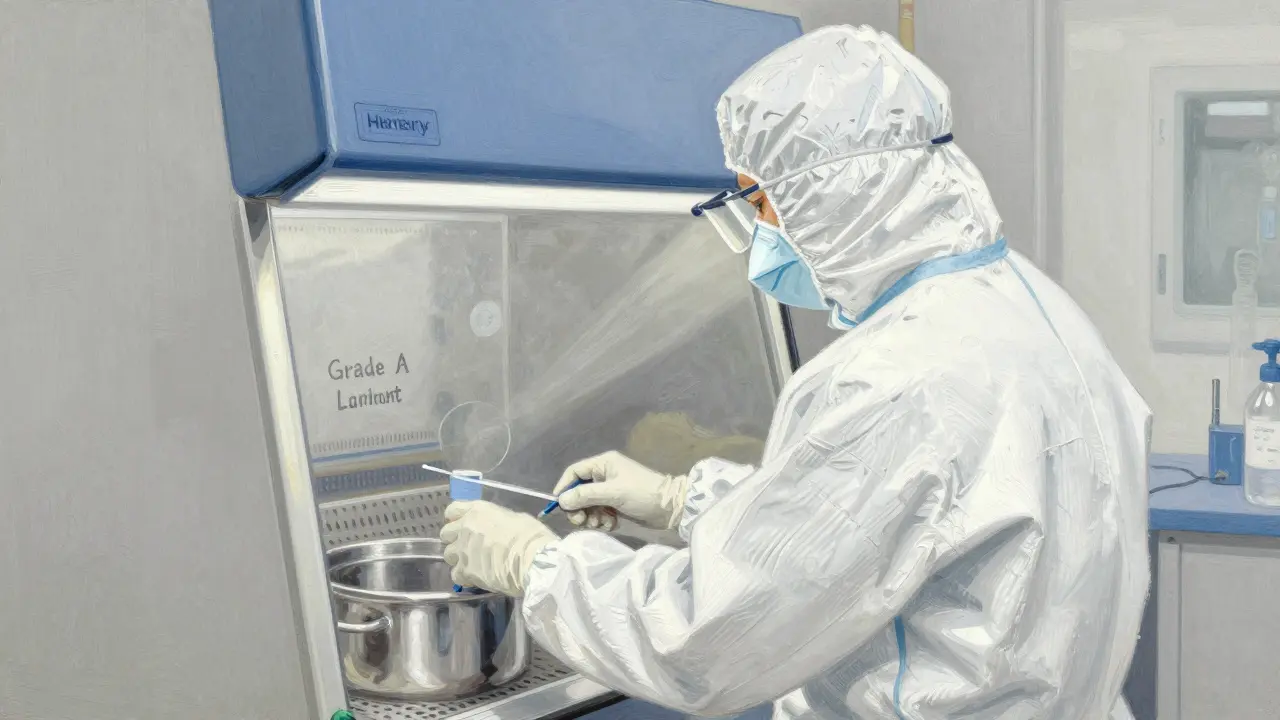
Contamination Control: More Than Just Filters
It's a common misconception that a high-end HEPA filter is the only thing that matters. While H13 or H14 filters are essential for trapping 99.9% of particles, the biggest threat to a cleanroom isn't the air-it's the people. Humans are essentially particle generators. We shed skin, hair, and microbes every second. This is why gowning procedures are the most frequent source of deviations in generic manufacturing. If a technician's glove tears or they fail to tuck a stray hair into their hood, the entire batch is at risk. Modern facilities are moving toward isolator technology to remove the human element entirely. By placing the product in a sealed chamber and using robotic arms or glove ports, companies like Teva have successfully slashed their contamination events. This shift doesn't just protect the drug; it protects the company from the nightmare of an FDA Form 483 observation or a warning letter, which can freeze production and crash a stock price overnight.Navigating Global Regulatory Differences
If you're selling generics globally, you're playing a game of regulatory whack-a-mole. While there is a push for harmonization through the ICH (International Council for Harmonisation), differences still exist. The FDA's rules in 21 CFR 211.46 focus heavily on the design of the facility to prevent contamination, but they aren't always as explicit about ISO classes as the European standards. Meanwhile, the Japanese Pharmaceutical Affairs Law often requires additional monitoring at the 1.0μm particle size, which means your monitoring equipment needs to be calibrated differently for the Japanese market. For those dealing with compounding pharmacies, the USP Chapter <797> provides a different set of rules. These are generally less stringent than full-scale manufacturing, allowing for ISO Class 7 buffer areas where a factory would demand ISO Class 5. This distinction is vital because trying to apply pharmacy standards to a manufacturing plant is a fast track to a regulatory shutdown.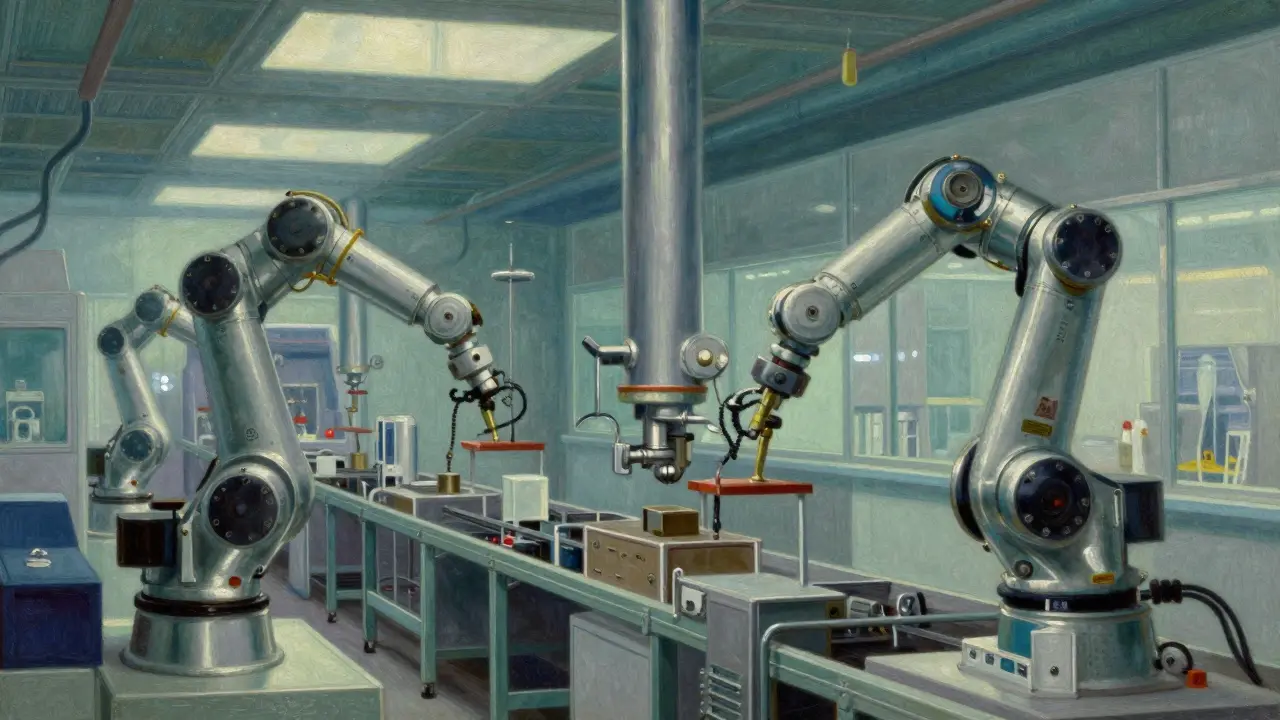
Future Trends: AI and Automation
The future of cleanrooms is looking less like a sterile hospital and more like a high-tech server farm. We are seeing a shift toward "Continuous Manufacturing," where the drug is produced in a steady flow rather than in batches. This requires a total rethink of cleanroom design, as the environmental controls must be integrated directly into the production line. AI-powered monitoring is also starting to take hold. Instead of a technician manually taking air samples and waiting for lab results, real-time sensors can now detect a pressure drop or a particle spike the moment it happens. This allows managers to stop a line before a batch is ruined, rather than discovering the error days later during a quality review. McKinsey projects that this wave of automation could reduce operational costs by up to 30% by 2028. For generic manufacturers, this is a lifeline. It lowers the barrier to entry for complex generics and biosimilars, which are projected to make up half of all new ANDA submissions by 2025.What is the main difference between Grade A and Grade B cleanrooms?
Grade A is the most critical zone, used for high-risk operations like aseptic filling, and requires unidirectional (laminar) airflow to ensure particles are immediately swept away. Grade B is the supporting environment-the room surrounding the Grade A zone-where the air is still highly filtered but does not necessarily have the same unidirectional flow requirements during operation.
Why are cleanroom standards so strict for generic drugs?
Generic drugs must demonstrate bioequivalence and quality equivalence to the reference listed drug (the original brand name). If a generic is contaminated, it fails the quality equivalence test, making it impossible to gain FDA approval through an ANDA submission. Regulatory bodies ensure that the lower price of generics doesn't come at the expense of patient safety.
How does ISO 14644-1 relate to GMP grades?
ISO 14644-1 is a global technical standard that classifies air cleanliness based on particle counts. GMP (Good Manufacturing Practice) grades are regulatory classifications used by health authorities. In simple terms, a GMP Grade A area is typically designed to meet the technical requirements of an ISO Class 5 environment.
What happens if a manufacturer fails a cleanroom inspection?
Failure can lead to a variety of penalties, starting with an FDA Form 483, which lists observations of non-compliance. If not corrected, this can escalate to a Warning Letter, an Import Alert (blocking the drugs from entering the US), or a Consent Decree, where a court-ordered monitor oversees the facility. In severe cases, it leads to massive product recalls and total facility shutdown.
Are Grade C or D environments sufficient for non-sterile pills?
Yes, for oral solids (like tablets), the requirements are generally less stringent than for injectables. However, there is an ongoing industry debate. Some experts argue that Grade C requirements for non-sterile solids are an unnecessary expense, citing studies that show no difference in drug dissolution between Grade C and Grade D facilities.