
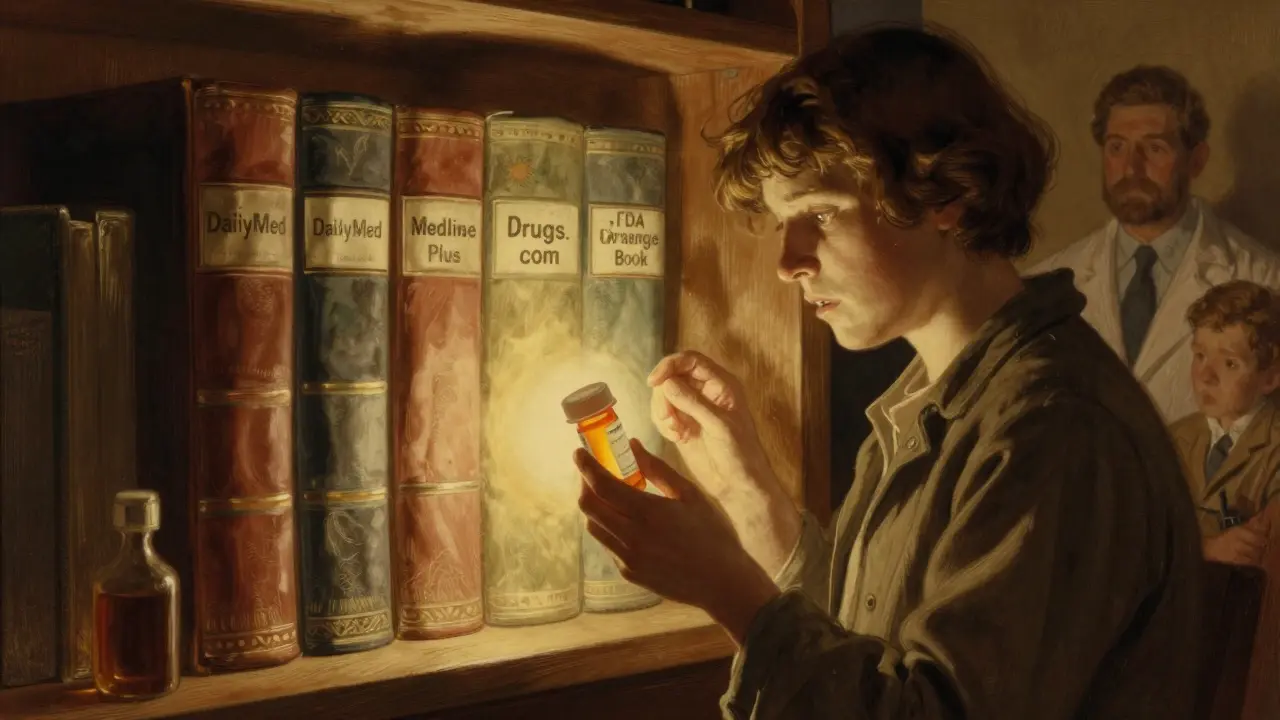
Why generic drug information matters more than you think
More than three out of every four prescriptions filled in the U.S. are for generic drugs. That’s not just a trend-it’s the new normal. But here’s the problem: not all generic drugs are created equal. Some work exactly like the brand name. Others? Not so much. And if you’re taking levothyroxine, warfarin, or epilepsy meds, even tiny differences in how your body absorbs the drug can mean serious side effects or treatment failure.
That’s why knowing where to find accurate, up-to-date information on generic drugs isn’t just helpful-it’s essential. Whether you’re a patient trying to understand your prescription, a caregiver helping someone manage multiple meds, or even a healthcare worker needing quick confirmation, having the right source can prevent mistakes, reduce anxiety, and even save lives.
But with so many websites out there claiming to offer drug info, how do you know which ones actually靠谱? Not all drug sites are created equal. Some are run by pharmacies, others by companies trying to sell you something. A few are backed by the federal government-and those are the ones you want.
DailyMed: The official source for FDA-approved drug labels
If you need to know exactly what the FDA says about a generic drug-its ingredients, warnings, dosing, side effects, and how it’s supposed to be used-DailyMed is the only place that gives you the raw, unedited label directly from the manufacturer and approved by the FDA.
It’s not flashy. The website looks like it’s from 2005. But that’s because it’s not meant for casual browsing. It’s built for accuracy. Every drug listing comes from Structured Product Labeling (SPL), a machine-readable format that hospitals and pharmacies use to update their systems. As of late 2023, DailyMed had over 92,000 drug entries, updated within 72 hours of any FDA change.
For pharmacists and doctors, DailyMed is the gold standard. It’s the first place they check when verifying a substitution or answering a legal question about labeling. If you’re ever in doubt about whether a generic version is legally equivalent to the brand, DailyMed is your answer.
But here’s the catch: it’s written for professionals. The language is dense. Warnings are buried in paragraphs. If you’re not familiar with medical terms like "bioavailability" or "therapeutic equivalence," you might walk away more confused than when you started.
MedlinePlus: The easiest place for patients to understand their meds
Now, if you’re a patient-or helping someone who is-MedlinePlus is your best friend. Run by the National Library of Medicine, it takes the same FDA-approved data from DailyMed and turns it into plain English. No jargon. No fine print. Just clear explanations written at a 6th to 8th-grade reading level.
It covers over 17,500 drugs, herbs, and supplements. You can search by brand name, generic name, or even what the pill looks like. Each page includes: what the drug is used for, how to take it, what to avoid, common side effects, and what to do if you miss a dose. It even has videos and printable sheets.
And it’s free. No sign-up. No ads. No hidden paywalls. It’s funded by the U.S. government, so there’s no incentive to push certain products. In fact, a 2023 NIH study found that 94% of patients could find the information they needed on MedlinePlus without help.
It’s the only consumer-facing site recommended by the Institute for Safe Medication Practices. If you’re worried about a new prescription, or you’re helping an elderly parent understand their meds, start here.
Drugs.com: The fast, all-in-one tool for quick checks
Drugs.com is the middle ground. It’s not government-run, but it’s trusted by millions of patients and professionals alike. Founded by a pharmacist in 1999, it pulls data from FDA labels, professional databases like Micromedex, and clinical guidelines-all updated daily.
What makes it stand out? Speed and features. Need to know if your generic ibuprofen interacts with your blood pressure pill? Type both in, and it tells you instantly. Worried about side effects? It lists them by frequency. Want to know what your pill looks like? Use the Pill Identifier tool-it works 89% of the time.
It’s also mobile-friendly. The app gets 4.6 stars on the App Store. People use it in the pharmacy line, at the doctor’s office, or late at night when they’re worried. It’s not perfect-there are ads, and some users complain they’re too intrusive-but for a free tool, it’s one of the most complete.
And unlike DailyMed, you don’t need a medical degree to use it. If you want something fast, reliable, and easy to understand, Drugs.com is your go-to.
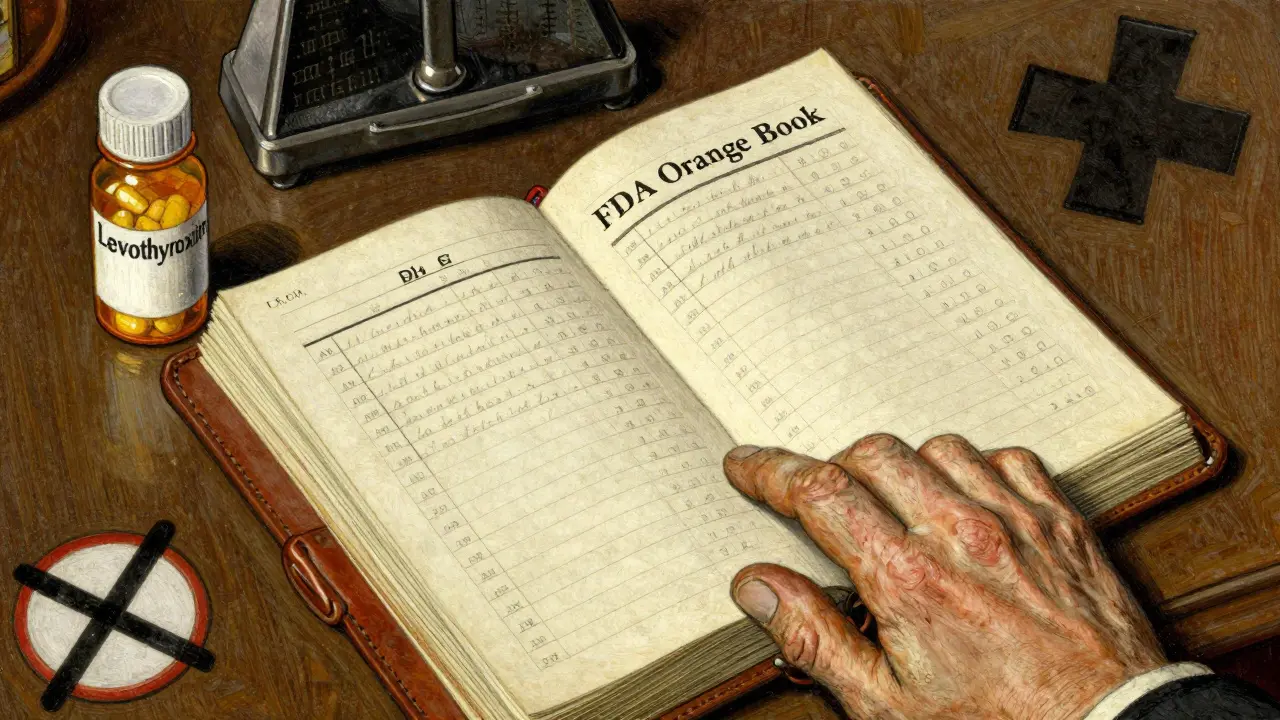
The FDA Orange Book: For when you need to know if generics are truly interchangeable
Here’s something most people don’t realize: not every generic drug is approved as a direct substitute for the brand. That’s where the FDA’s Orange Book comes in. Officially called "Approved Drug Products with Therapeutic Equivalence Evaluations," it’s a list of all generic drugs the FDA has reviewed and rated for interchangeability.
Each drug gets a code: AB means it’s therapeutically equivalent. BX means it’s not. For drugs like levothyroxine, warfarin, or certain seizure meds, that code matters. A BX rating doesn’t mean the generic is bad-it just means the FDA hasn’t confirmed it works exactly the same as the brand in every patient.
As of late 2023, the Orange Book listed over 20,000 generic products. You can search it for free online. It’s updated monthly. And if you’re a pharmacist or a patient on a narrow-therapeutic-index drug, this is the document you should check before accepting a substitution.
It’s not user-friendly. The interface is clunky. But it’s the only official source that tells you whether your pharmacy can legally swap your generic without your doctor’s approval.
How professionals use these tools-real-world breakdown
Here’s how this plays out in real life:
- Patients: Start with MedlinePlus. If you need more detail, go to Drugs.com. Only check DailyMed or the Orange Book if you’re digging into a specific concern.
- Pharmacists: Use DailyMed for legal compliance, Drugs.com for quick checks, and the Orange Book to confirm substitutions. Many also use Lexicomp or Clinical Pharmacology for complex cases-but those cost money.
- Doctors: Often use Epocrates or Drugs.com for point-of-care decisions. They’ll refer patients to MedlinePlus for education.
- Caregivers: MedlinePlus is your safest bet. It’s clear, free, and updated by experts who don’t have a sales pitch.
And here’s what most people don’t realize: 92% of hospital pharmacists use at least two of these resources every day. No single site has everything. That’s why experts always recommend cross-checking.
What to avoid: The risky sites you should never trust
There are thousands of websites that claim to offer drug information. Many are well-designed, look professional, and even have "FDA-approved" logos.
But here’s the truth: if a site is trying to sell you supplements, push a specific brand, or requires you to sign up for a newsletter to see basic info-it’s not reliable. Avoid sites that:
- Don’t list their sources
- Use phrases like "miracle cure" or "natural alternative"
- Are run by companies that sell the drugs they describe
- Don’t update their content regularly
Some popular sites you might have seen-like WebMD or Healthline-are great for general health advice, but they’re not designed for detailed drug comparisons. They often summarize, not cite. For generic drug specifics, stick to the government-backed and professional sources listed above.

What’s changing in 2026
Things are getting better. In late 2023, the FDA launched a new version of the Orange Book with improved search tools and API access so EHR systems can pull data automatically. MedlinePlus is adding multilingual safety alerts in 15 languages by November 2024. DailyMed’s API is now integrated into most major electronic health records.
But the biggest shift? More people are realizing that free, government-run resources aren’t outdated-they’re essential. With 78% of prescriptions being generics, and medication errors still linked to confusion over generic names, reliable info isn’t a luxury. It’s a public health need.
Quick summary: Where to go for what
- Need clear, simple explanations? → MedlinePlus
- Need the official FDA label? → DailyMed
- Need to check drug interactions fast? → Drugs.com
- Need to know if a generic is officially interchangeable? → FDA Orange Book
Frequently Asked Questions
Are generic drugs really as good as brand-name drugs?
Yes-by law, the FDA requires generic drugs to have the same active ingredient, strength, dosage form, and route of administration as the brand name. They must also prove they’re absorbed in the body at the same rate and amount. But there’s a small exception: for drugs with a narrow therapeutic index (like levothyroxine or warfarin), even tiny differences can matter. That’s why the FDA’s Orange Book lists which generics are rated as fully interchangeable (AB) and which aren’t (BX).
Can I trust Drugs.com if it’s not a government site?
Yes, but with context. Drugs.com is run by a pharmacist and pulls data from FDA labels, AHFS DI, and Micromedex-all trusted professional sources. It’s not official like DailyMed, but it’s one of the most accurate free consumer tools available. Its interaction checker has been validated in studies by Johns Hopkins. Just don’t rely on it for legal or regulatory decisions-that’s what DailyMed and the Orange Book are for.
Why does DailyMed look so outdated?
It’s designed for accuracy, not aesthetics. DailyMed is built to feed data directly into hospital systems and pharmacy software. The plain layout ensures the information stays consistent and machine-readable. While it’s not user-friendly for casual browsing, it’s the most reliable source for the exact wording approved by the FDA. Think of it like a legal document-it’s not pretty, but it’s the only one that matters in court.
Is MedlinePlus available in languages other than English?
Yes. MedlinePlus offers drug information in Spanish, and over 450,000 monthly visitors use the Spanish version. By November 2024, it will add multilingual safety alerts in 15 languages, including Mandarin, Arabic, Vietnamese, and Russian. This expansion is part of a $15 million federal initiative to reduce health disparities.
Do I need to pay for better drug information?
For most people, no. MedlinePlus, DailyMed, Drugs.com, and the FDA Orange Book are all free and cover the vast majority of needs. Paid tools like Lexicomp or Clinical Pharmacology offer faster access, AI-powered alerts, and deeper clinical insights-but they’re mainly used in hospitals, clinics, and research settings. If you’re a patient or caregiver, the free tools are more than enough.
What should I do if my pharmacy switches my generic without telling me?
Check the Orange Book to see if the new generic has an AB rating. If it does, it’s legally considered interchangeable. If it’s BX, your pharmacist should have gotten your doctor’s approval before switching. You have the right to ask why the change was made and to request the original brand or a different generic. If you notice new side effects after the switch, contact your doctor and mention the change.
Next steps: What to do today
Don’t wait until you’re confused or worried. Take five minutes now:
- Go to medlineplus.gov and search for your most common medication.
- Bookmark DailyMed (dailymed.nlm.nih.gov) for when you need the official label.
- Download the Drugs.com app for quick checks on the go.
- If you’re on a high-risk medication like levothyroxine, look up your drug in the FDA Orange Book to confirm its rating.
Knowing where to find reliable info isn’t just smart-it’s part of taking control of your health. And with generics making up nearly 8 out of 10 prescriptions, you’ll use this knowledge more than you think.