
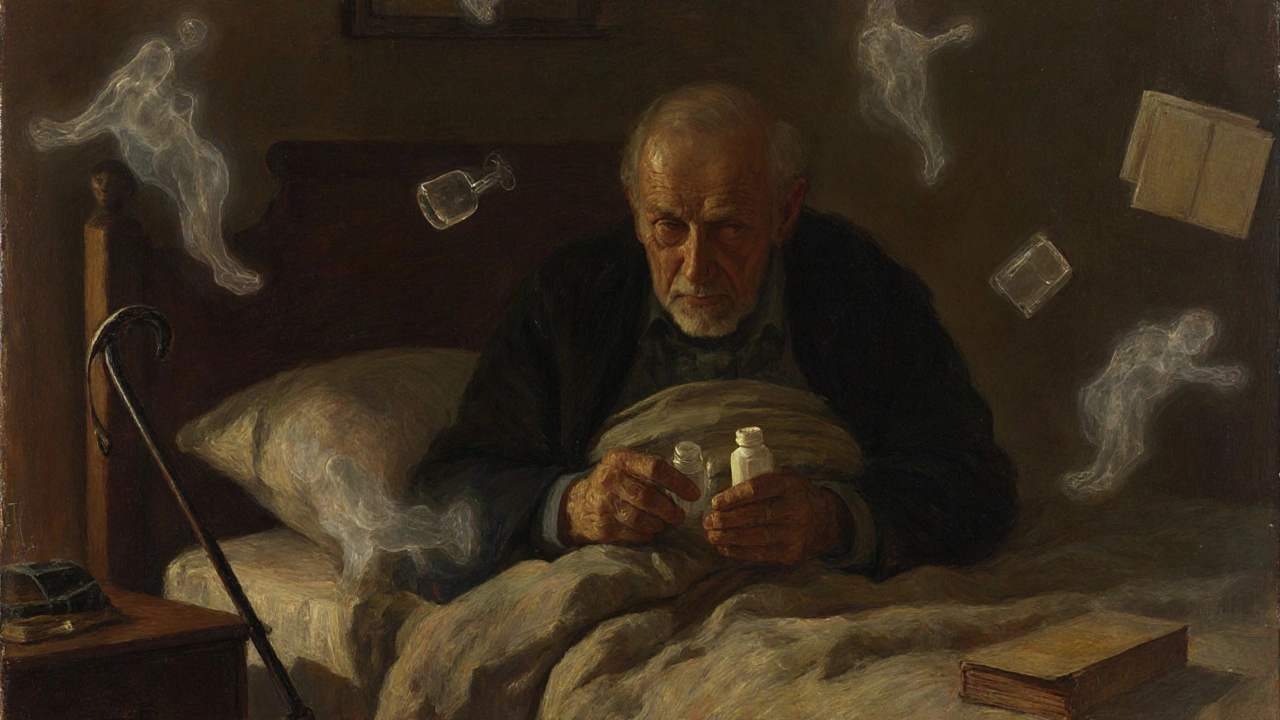
For millions of older adults, a small white pill labeled benzodiazepine has become a daily ritual-taken for sleep, for anxiety, for calm. But what if that pill is doing more harm than good? In 2025, the medical community is sounding the alarm: benzodiazepines like Xanax, Valium, and Ativan are among the riskiest medications for seniors, and safer options exist.
Why Benzodiazepines Are Dangerous for Seniors
Benzodiazepines work by boosting GABA, a calming chemical in the brain. That sounds helpful, right? But in older adults, the body doesn’t process these drugs the same way. Liver function slows down. Brain receptors become more sensitive. The result? Even small doses can cause dizziness, confusion, and extreme drowsiness.These side effects aren’t just uncomfortable-they’re deadly. Studies show seniors on benzodiazepines have at least a 50% higher risk of falling and breaking a hip. One study of over 43,000 people found that taking zolpidem (a common sleep pill) raised hip fracture risk by more than two and a half times. And it’s not just falls. Driving while on these drugs is like driving with a blood alcohol level of 0.05% to 0.079%. That’s legally impaired in most places.
The cognitive risks are even more alarming. Long-term use is linked to memory loss, brain fog, and a sharp increase in dementia risk. Research from French and Canadian teams found that seniors who took benzodiazepines for 3 to 6 months had a 32% higher chance of developing Alzheimer’s. If they took them for more than six months? The risk jumped to 84%. The longer the use, the higher the dose, the worse the outcome.
And here’s the kicker: these drugs don’t work well over time. They might help you sleep the first week, but after a few weeks, your body gets used to them. You need more to get the same effect. Then, when you try to stop? Rebound insomnia hits hard. Anxiety comes back stronger. Many seniors end up trapped-needing the drug just to feel normal.
Who’s Still Prescribing Them?
Despite clear warnings from the American Geriatrics Society since 2019, benzodiazepines are still being given to 8.9% of seniors over 65. That’s nearly 1 in 11 older adults. And a shocking 31% of those prescriptions are for long-term use-months or even years. Many doctors still see these drugs as a quick fix for anxiety or insomnia, especially when time is short and patients are frustrated.But guidelines like the Beers Criteria and STOPP are crystal clear: avoid benzodiazepines in older adults unless absolutely necessary. Even short-term use carries risks. Dr. Michael Steinman from UCSF, who helped write the Beers Criteria, says, “We underestimate these risks every single day.”
It’s not just doctors. Many seniors believe these pills are safe because their doctor prescribed them. A Reddit user who works in geriatric care shared that 9 out of 10 elderly patients she sees think their Xanax is harmless. That’s a dangerous myth. The truth? Benzodiazepines have an average patient rating of 5.2 out of 10 for seniors-far lower than non-benzodiazepine alternatives.

Safer Alternatives for Anxiety and Insomnia
The good news? You don’t need benzodiazepines to manage anxiety or sleep issues in older age. There are safer, more effective options.Cognitive Behavioral Therapy for Insomnia (CBT-I) is the gold standard. It’s not a pill-it’s a structured program that teaches you how to retrain your brain for better sleep. Studies show 70-80% of seniors who complete CBT-I see lasting improvement. And unlike pills, the benefits keep growing. Medicare now covers CBT-I under its Behavioral Health Integration benefit, but only 12% of eligible seniors are using it-mostly because providers aren’t referring them.
SSRIs and SNRIs like sertraline (Zoloft) or venlafaxine (Effexor) are first-line treatments for anxiety in older adults. They take 4 to 6 weeks to work, but they don’t cause drowsiness, memory loss, or falls. They also don’t lead to dependence. For seniors with depression and anxiety, these are often the best long-term solution.
Ramelteon (brand name Rozerem) is a melatonin receptor agonist approved for sleep onset problems. It doesn’t affect memory or balance. It’s not a sedative-it helps reset your body clock. It’s not perfect for staying asleep, but it’s much safer than anything in the benzodiazepine family.
And what about old-school sleep aids like diphenhydramine (Benadryl)? Avoid them. These antihistamines have strong anticholinergic effects, which are directly linked to higher dementia risk. They’re often sold over-the-counter as “natural” sleep aids, but they’re just as dangerous as benzodiazepines for seniors.
How to Safely Stop Taking Benzodiazepines
If you or a loved one has been on benzodiazepines for months or years, stopping suddenly can be dangerous. Seizures, severe anxiety, and hallucinations can happen. The key is a slow, supported taper.The American Society of Addiction Medicine recommends reducing the dose by 5-10% every 1 to 2 weeks. For some seniors, that means tapering over 6 to 12 months. It’s not fast, but it’s safe. Working with a doctor who understands deprescribing is critical.
The most successful tapers include CBT. One study found that 65% of seniors successfully stopped benzodiazepines when CBT was part of the plan. Without it, only 35% made it through. Therapy helps manage the return of anxiety or insomnia without reaching for a pill.
Family support matters too. Caregivers often resist stopping the medication because they see the immediate calm it brings. But they need to understand: that calm is temporary. The long-term cost is confusion, falls, and memory loss.

What’s Changing in 2025?
The tide is turning. CMS, Medicare’s managing agency, launched the Beers Criteria Action Plan in January 2025. Its goal? Cut inappropriate benzodiazepine prescribing by 50% by 2027. That means doctors will be flagged if they prescribe these drugs to seniors without a clear, documented reason.The FDA now requires updated labels on all benzodiazepine packaging to warn about dementia risk in older adults. The NIH is funding a major five-year trial called BRIGHT, testing telehealth-based deprescribing programs. Results won’t come until 2029, but the direction is clear: the medical system is moving away from these drugs.
Pharmaceutical sales data shows benzodiazepine prescriptions for seniors are falling at 5.2% per year. Meanwhile, safer alternatives like SSRIs and melatonin agonists are growing at 9.3% annually. The market is responding to the science.
What You Can Do Today
If you’re a senior on benzodiazepines:- Don’t stop cold turkey. Talk to your doctor about tapering.
- Ask if CBT-I or an SSRI could help instead.
- Bring a family member to your appointment. They can help ask questions you might forget.
- Check your pill bottle. If it says “take as needed,” you might be taking it daily without realizing it.
If you’re a caregiver or family member:
- Watch for signs of dizziness, confusion, or falls.
- Don’t assume the pill is safe just because it’s prescribed.
- Look into local CBT-I programs. Some community health centers offer them for free or low cost.
- Join a support group like the Benzodiazepine Information Coalition-they have over 12,500 members.
The goal isn’t to scare you. It’s to empower you. There’s no shame in needing help with sleep or anxiety. But there’s real risk in relying on a drug that’s been proven to harm more than help in older adults. The safer path exists. It just takes a conversation to start it.
Are benzodiazepines ever safe for seniors?
Benzodiazepines are rarely appropriate for seniors. They may be used briefly-for example, during a severe panic attack or before a medical procedure-but only under close supervision. Long-term use for anxiety or insomnia is strongly discouraged by the American Geriatrics Society and other major medical groups. Even short-term use increases fall and cognitive risks.
How long does it take to safely stop taking benzodiazepines?
Tapering usually takes 8 to 16 weeks for most seniors, but for those on high doses or long-term use, it can take 6 to 12 months. The key is slow, steady reductions-no more than 5-10% of the current dose every 1-2 weeks. Rushing the process raises the risk of withdrawal symptoms like rebound anxiety, insomnia, or seizures.
Can CBT-I really replace sleeping pills for seniors?
Yes. CBT-I is the most effective long-term treatment for insomnia in older adults. Studies show 70-80% of seniors who complete the program see lasting improvements in sleep quality without any medication. Unlike pills, the benefits continue to grow after treatment ends. Medicare now covers CBT-I, but access is still limited due to provider shortages.
Why are antihistamines like Benadryl dangerous for seniors?
Antihistamines like diphenhydramine block acetylcholine, a brain chemical critical for memory and thinking. This is called an anticholinergic effect. Long-term use is linked to higher dementia risk and confusion. Even over-the-counter sleep aids containing these drugs are unsafe for seniors. They’re often marketed as natural, but they’re just as risky as benzodiazepines.
What should I do if my doctor won’t help me stop benzodiazepines?
Ask for a referral to a geriatrician or a pharmacist specializing in deprescribing. Many hospitals and community health centers now have deprescribing clinics. You can also contact the Benzodiazepine Information Coalition for resources and support. Bring printed guidelines from the American Geriatrics Society Beers Criteria to your appointment-it gives you leverage in the conversation.
doug schlenker
November 29, 2025 AT 03:23I've seen this play out with my dad. He was on lorazepam for 7 years for 'anxiety'-turns out he just needed more structure, better sleep hygiene, and someone to talk to. When we finally tapered him off with CBT-I, his balance improved, his memory cleared up, and he started gardening again. No more confusion at breakfast. It wasn't easy, but it was worth it.
Doctors need to stop treating seniors like they're broken machines that need a quick fix.
Olivia Gracelynn Starsmith
November 30, 2025 AT 08:30CBT-I is the real MVP here. I'm a geriatric nurse and I've watched seniors transform after just 6 weeks of therapy. No pills. No side effects. Just better sleep because their brain finally learned how to shut off. The problem? Most providers don't even know where to refer patients. Medicare covers it but nobody tells them. We're failing our elders by not pushing this harder.
Also-diphenhydramine is a silent killer. Stop calling it 'natural.' It's not. It's brain poison with a pretty label.
Skye Hamilton
December 1, 2025 AT 10:33So let me get this straight-you’re telling me the same drugs that help my 82-year-old aunt sleep through the night are secretly turning her into a walking dementia patient? Cool. So the solution is… therapy? That’s gonna take months. Meanwhile she’s up at 3am screaming at the TV because she thinks the cat is stealing her socks. I’ll stick with the pill thanks.
Also why is everyone so obsessed with making old people ‘safe’ but never actually asking them what they want?
Maria Romina Aguilar
December 1, 2025 AT 15:09Are we really sure about the dementia link? I mean… correlation isn’t causation… right? And what about the placebo effect in the studies? And what if the seniors who took benzos were already more likely to have cognitive decline because they were more anxious to begin with? I’m not saying it’s safe… but maybe we’re oversimplifying? Also-why is everyone ignoring the fact that some people just… need something to calm down? Not everyone can do CBT. Not everyone has access. Not everyone wants to.
Brandon Trevino
December 3, 2025 AT 08:32The data is unequivocal. Benzodiazepines in the elderly are not merely suboptimal-they are iatrogenic disasters. The Beers Criteria, STOPP, and multiple meta-analyses including those from JAMA and The Lancet Geriatrics converge on a single conclusion: risk outweighs benefit by a factor of 3:1 to 5:1. The 84% increased Alzheimer’s risk for long-term users is not anecdotal-it is hazard ratio-adjusted, longitudinal, and dose-dependent. To continue prescribing these agents is not clinical practice-it is negligence dressed in white coats.
Also: diphenhydramine is a Class 1 anticholinergic. It belongs in the same category as tricyclic antidepressants for dementia risk. Calling it 'natural' is marketing fraud.
Denise Wiley
December 3, 2025 AT 09:03My grandma was on Xanax for 12 years. She didn’t even know she was taking it daily-her prescription said 'as needed' but she took it every night because she was scared to sleep without it. When we finally got her off it with a slow taper and CBT-I? She cried. Not from withdrawal-from relief. She said, 'I finally feel like me again.'
Stop treating seniors like they’re too old to change. They’re not broken. They’re just tired of being treated like liabilities.
Also-tell your doctor to stop prescribing this junk. Bring this article. Print it. Hand it to them. It’s not rude. It’s survival.
kaushik dutta
December 3, 2025 AT 23:55As someone who grew up in a culture where elders are revered but medicated into silence, I’ve seen this pattern everywhere-India, the US, everywhere. We don’t ask elders what they need-we just give them a pill to make them quiet. Benzodiazepines are the modern version of sedating the elderly to keep them out of the way. It’s not medicine-it’s social control wrapped in a prescription.
CBT-I? It’s not just a therapy-it’s a rebellion against the medical-industrial complex that profits from dependency. And yes, it takes time. But so does dignity. So does autonomy. So does a life lived with clarity, not chemical fog.
Let’s stop pathologizing aging. Sleeplessness isn’t a disease. Anxiety isn’t a disorder-it’s a response to loneliness, to loss, to a world that forgets you. Fix the environment. Don’t just numb the person.
Hannah Magera
December 5, 2025 AT 14:55Wait so if I’m 70 and have trouble sleeping, what do I do instead of the pill? Just talk to someone? That sounds nice but what if I don’t have anyone to talk to? Or I’m too tired to drive to a therapist? Or I can’t afford it? I just want to sleep. Is there anything… simpler? Like a vitamin or something?